
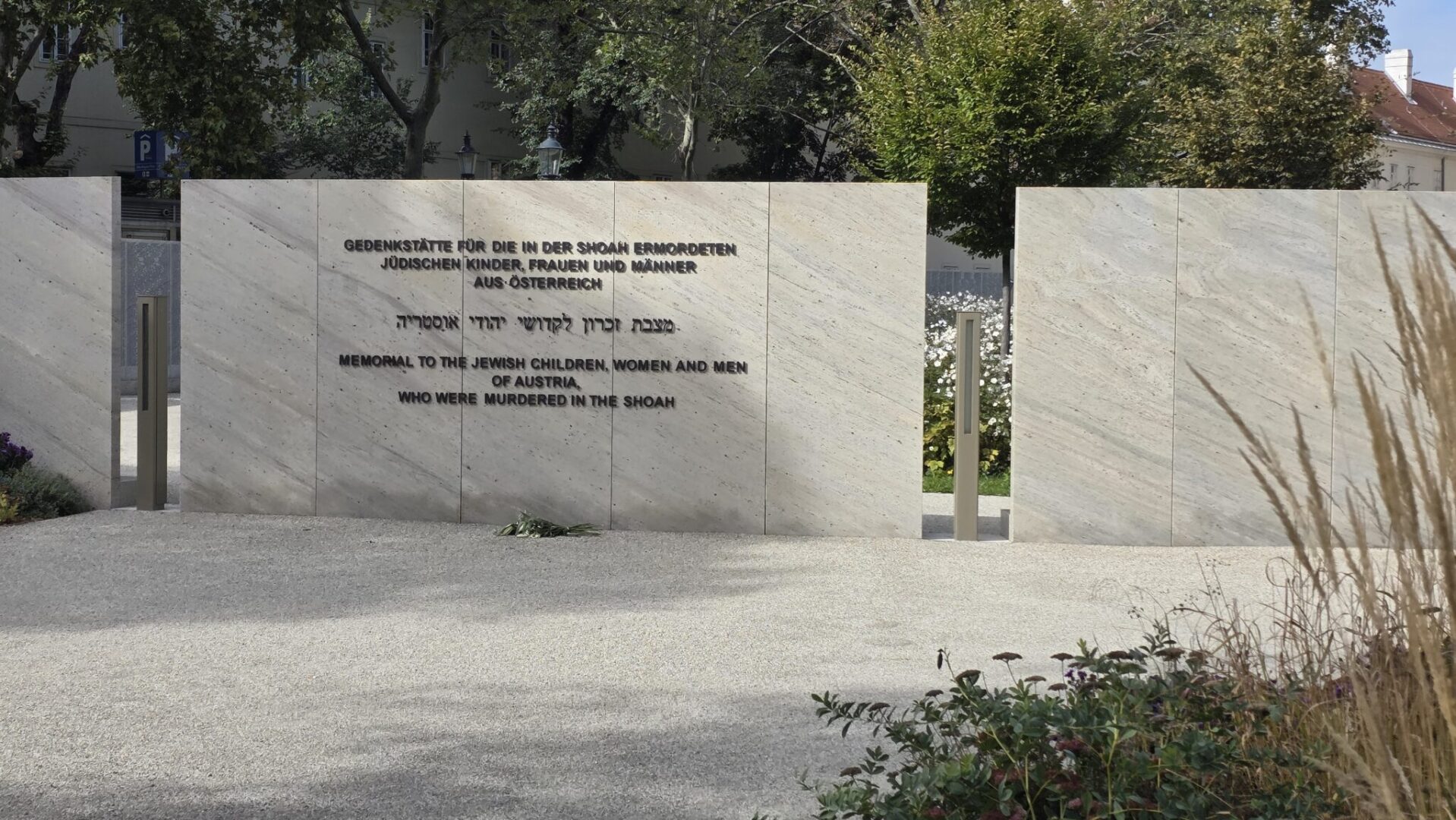
Today, when I opened Instagram, I saw Austrian President Alexander Van der Bellen again, this time at a wreath-laying ceremony in memory of the victims of the November pogroms of 1938, known as “Kristallnacht”. The ceremony took place at the Wall of Names memorial to the victims of the Holocaust in Vienna. Living in Austria, especially in its capital, you are constantly confronted with reminders of this terrible period of history. In Russia, unfortunately, people talk far less about such pogroms, although the history of violence against Jews there was also terrible. I have always been struck by how antisemitic attitudes can coexist with an unwillingness to openly discuss antisemitism itself. In Austria, as far as I can judge, this subject receives much more attention.
When you walk around Vienna’s 3rd district, where Julia and I live now, you can unexpectedly come across traces of entirely different historical eras. For example, one house has a memorial plaque saying that it was here, in 1192, that the English king Richard the Lionheart was captured. You must admit it’s quite astonishing to realise that a man we know from the Middle Ages once walked these streets. And just a few blocks away, on Hagenmüllergasse, you can see a historical photograph and a memorial plaque dedicated to the events of March 1938, when, after the Anschluss, Jewish residents of Vienna, including local traders, were forced to scrub political slogans supporting Austrian independence off the pavement on their knees. It all happened in front of onlookers, accompanied by mockery and the public humiliation of the people involved.
Such memorial places make you feel especially keenly what a huge historical burden present-day Vienna carries. Behind the façades of ordinary buildings lie events separated by centuries, and sometimes it is enough to walk a few blocks to find yourself facing a reminder of one of the most terrible pages in European history.
And today, when you read the news and listen to speeches by some politicians in Europe and other countries, you can’t help running through how the events of the past unfolded. What worries me most is how easily political struggle starts to be built on hatred and prejudice again. And I am talking about both ultra-right and ultra-left movements. What puts me most on guard are populists, regardless of the ideology they represent. I believe such politicians cannot be trusted. All too often their drive to win voters’ support comes with a search for enemies onto whom responsibility for society’s problems can be shifted. After all, it can all begin with perfectly familiar political techniques. Someone tries to exploit voters’ fears, someone openly plays on existing prejudices, gradually making hatred of a particular group of people an acceptable part of public politics. And when the state begins to encourage such an attitude, in effect allowing people to hate one another, the consequences can be terrible. The moment I find especially dangerous is when verbal aggression stops being seen as something unacceptable and the humiliation of other people begins to find public justification. Past experience has already shown how short the path can be from such politics to open violence and terror.
In this respect the history of Vienna is especially telling. Antisemitism gained strength here over decades, gradually becoming a familiar instrument of political struggle. But after the Nazis came to power, events began to develop with incredible speed. In March 1938 Jewish residents were publicly humiliated on the city’s streets, and only 8 months later synagogues were being set on fire in Vienna, Jewish businesses and homes were being ransacked, and people were beaten, arrested and sent to concentration camps. That is why today I want to reconstruct in detail the chronology of the anti-Jewish pogroms that took place in Vienna on 9–10 November 1938. But to understand how the city arrived at these events, we need to go back several decades, to when antisemitism was gradually turning into one of the influential forces in Austrian political life.
At the end of the 19th century Vienna was the capital of the multinational Austro-Hungarian Empire and one of the largest cultural and economic centres of Europe. The city’s population was growing fast, partly thanks to Jewish families moving in from Galicia, Bohemia and Moravia. Jews played a prominent role in trade, medicine, journalism, science and the cultural life of the capital. At the same time, economic change and growing competition created favourable conditions for the spread of antisemitic sentiment, which nationalist political movements increasingly exploited.
One of the most influential figures of the movement was Karl Lueger (1844–1910). He began his political career in liberal circles, gradually moved closer to antisemitic movements in the 1880s, and in 1893 became a co-founder of the Christian Social Party. In 1895 Lueger was elected mayor of Vienna for the first time, but Emperor Franz Joseph I refused to confirm his appointment, partly because of the politician’s openly antisemitic stance. After several further elections Lueger nevertheless took office in April 1897 and remained at the head of the city until his death in 1910. His time in office saw the development of municipal infrastructure, public transport, and gas and electricity supply. At the same time, Jews faced discrimination in advancing through the municipal service and in obtaining city contracts, and supporters of the Christian Social Party urged people to buy goods exclusively from Christian traders.
Antisemitism existed in Vienna long before Lueger: as early as the second half of the 19th century, ideas of ethnic superiority were spread by radical German-nationalist movements, including supporters of Georg von Schönerer. After the collapse of the Austro-Hungarian Empire in 1918, these views did not disappear. Vienna was going through an economic crisis and bitter political struggle, although from 1919 the city was governed by the Social Democrats, who carried out large-scale social reforms known as the “Red Vienna” programme.
In the 1920s antisemitism was especially noticeable in the university environment. Radical students attacked Jews and socialists, started brawls, wrecked premises and intimidated lecturers. One of the places of such clashes was the First Anatomical Institute at Währinger Straße 13, headed by the physician and Social Democratic politician Julius Tandler. In 1932–1933 the unrest at the university became so serious that it attracted international attention. After Hitler came to power in Germany, the activity of Austrian National Socialists increased. Although the Austrian government banned the NSDAP in June 1933, its supporters continued to operate underground.
By the beginning of 1938 Vienna remained one of the largest centres of Jewish life in Europe. According to research by the historian Jonny Moser, published by the Documentation Centre of Austrian Resistance, about 206,000 people lived in Austria whom the Nazi racial laws would later classify as Jews. Approximately 167,000 members of the Jewish religious community were in Vienna itself.
On 11 March 1938 the Austrian chancellor Kurt Schuschnigg, under pressure from Nazi Germany, announced his resignation. The National Socialists, who until then had operated mostly underground, began to seize power, and as early as the night of 11 to 12 March attacks on Jews and political opponents of Nazism began in Vienna. On 12 March German troops entered Austria and were met with mass support from supporters of the Anschluss. The next day a law was passed incorporating the country into the German Reich, and on 15 March Hitler addressed a crowd of many thousands on Vienna’s Heldenplatz.
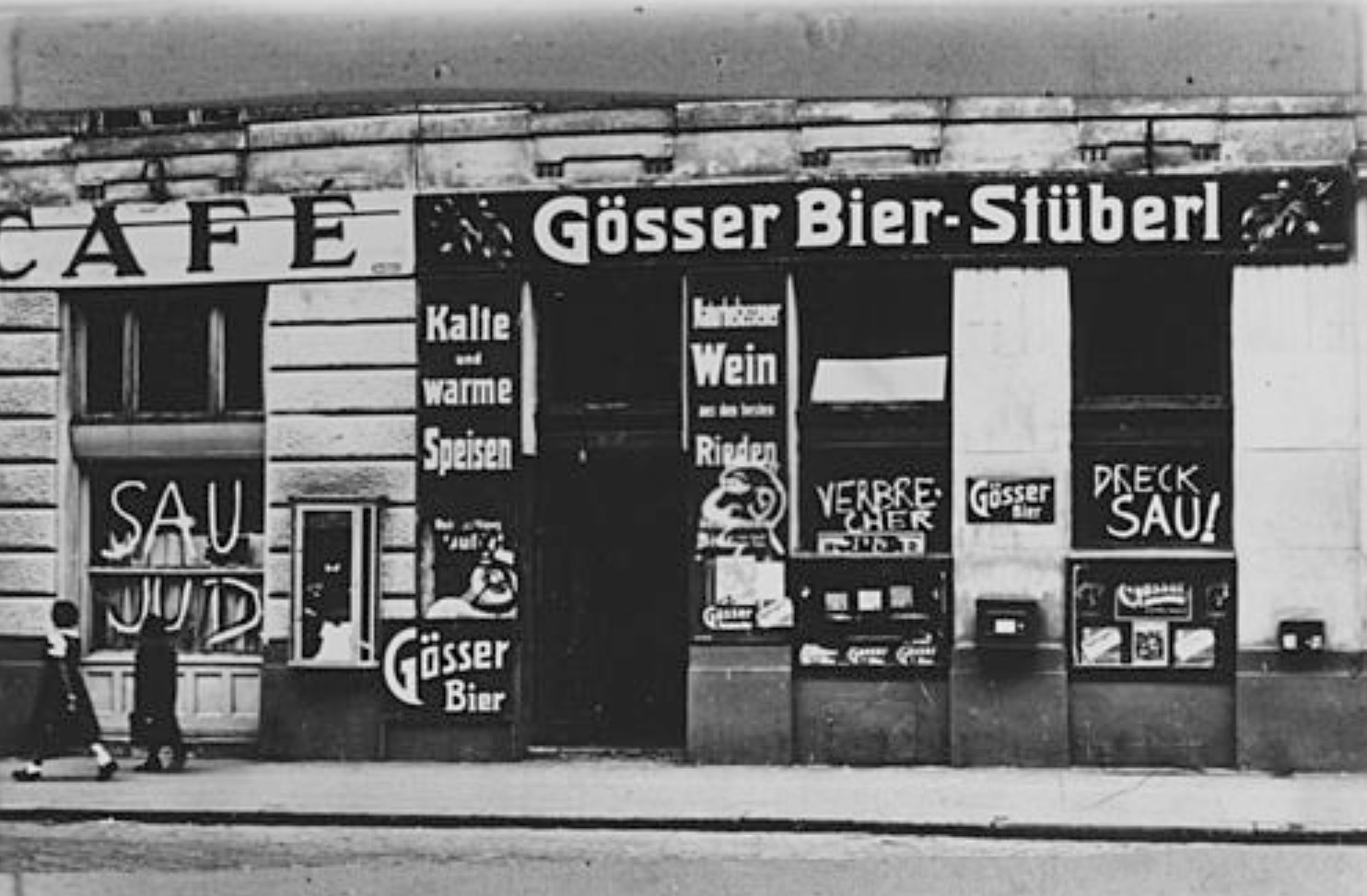
In the first days after the Anschluss, Jewish homes and businesses were attacked and looted. People were dismissed from their jobs, beaten, arrested, and forced to scrub political slogans supporting Austrian independence off the streets in public. Such abuse came to be called Reibpartien, literally “scrubbing squads”. They were often organised by local Nazi activists with the participation or approval of those around them.
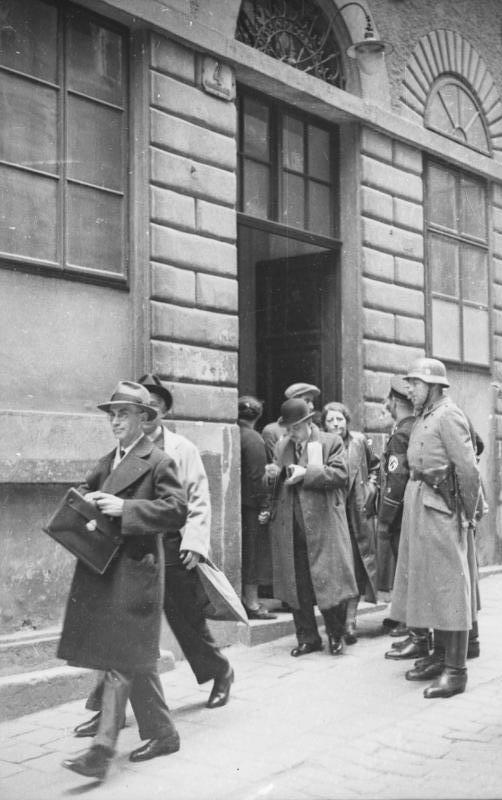
On 26 April 1938 a decree was issued requiring the compulsory registration of Jewish-owned property worth more than 5,000 Reichsmarks. On 20 May the Nuremberg Race Laws, which had been in force in Germany since 1935, came into effect in annexed Austria. They deprived Jews of equal civil rights and prohibited marriage, as well as intimate relations, between Jews and people whom Nazi legislation classed as of “German blood”. At the same time, Jewish teachers were dismissed from universities and schools, doctors and lawyers were deprived of the ability to practise their professions, and schoolchildren were transferred to separate schools. The Nazis called the seizure of Jewish property “Aryanisation” (Arisierung). Entrepreneurs were forced to sell their businesses for far less than their real value, and the money received often went into blocked bank accounts. In May 1938 a special Property Transfer Office, the Vermögensverkehrsstelle, was set up in Vienna to oversee the expropriation of Jewish businesses and other property.
In the summer, new discriminatory regulations appeared. A decree of 23 July provided for the introduction of special identity cards, and on 17 August the authorities required Jewish men to use the additional name “Israel” and Jewish women the additional name “Sara”, if their own first names were not on the approved lists. On 20 August the Central Office for Jewish Emigration (Zentralstelle für jüdische Auswanderung), organised with the participation of Adolf Eichmann, officially began work in Vienna. Its staff supervised departure procedures, which involved numerous checks, financial demands and the effective confiscation of a significant part of people’s property. At the same time, many states were reluctant to issue visas and demanded financial guarantees, which families who had lost their jobs and property often no longer had.
At the end of October the German authorities carried out a mass expulsion of Jews of Polish origin. Thousands of people were forcibly sent to the Polish border, where many ended up in harsh conditions, including in the area of the town of Zbąszyń. Among those affected was the family of 17-year-old Herschel Grynszpan, who was in Paris at the time. On 7 November 1938 Grynszpan went to the German embassy in Paris and shot the diplomat Ernst vom Rath. The wounds proved fatal, and the diplomat died on 9 November. Nazi propaganda immediately used the assassination to level accusations against the Jewish population as a whole.
Chronology of the November Events
On the evening of 9 November a meeting of the leaders of the National Socialist Party was being held in Munich, timed to coincide with the anniversary of the failed Beer Hall Putsch of 1923. Propaganda minister Joseph Goebbels spoke at it. He reported on antisemitic demonstrations taking place in some parts of Germany and made it clear that the Reich leadership did not intend to hinder them. According to surviving documents of the Nazi Party court, those present took his words as an instruction to organise mass attacks on Jews while maintaining the appearance of spontaneous popular outrage. At around 22:30 the heads of regional party organisations began passing the relevant instructions to their subordinates. After them, SA and SS units and other Nazi formations received their orders.
Surviving documents of Nazi institutions make it possible to reconstruct the subsequent sequence of events almost hour by hour. They have been studied, among others, by the historian Herbert Rosenkranz in his book Reichskristallnacht. 9. November 1938 in Österreich, published in Vienna in 1968, and by Wolfgang Scheffler, who put together a collection of archive materials on the November pogroms in 1978. One of the most important sources is the report of the Vienna branch of the SS Security Service dated 18 November 1938, which contains information on when orders were received, on the actions of the police and on the scale of the attacks.
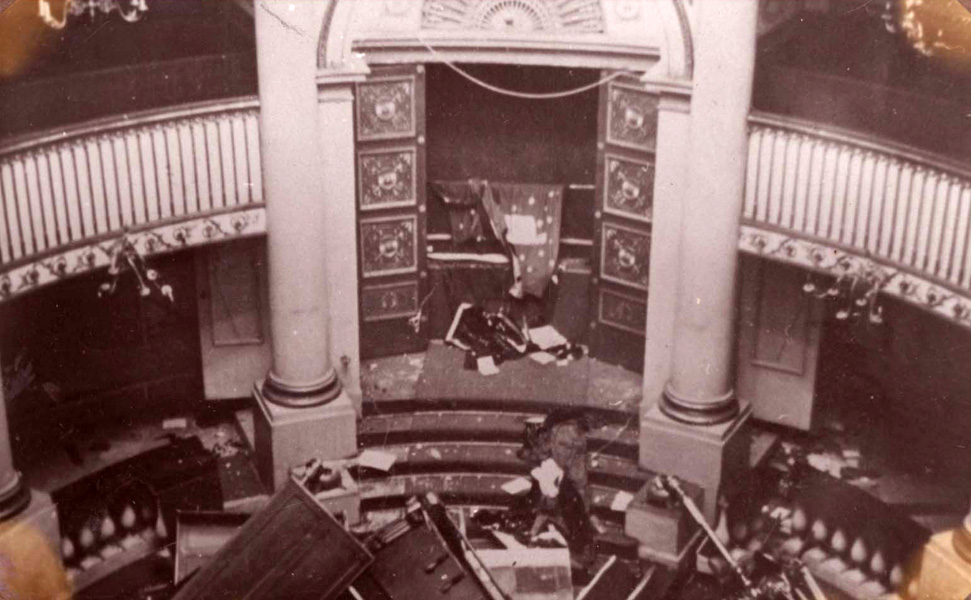
At around 23:00 on 9 November the first orders to carry out an anti-Jewish action reached Vienna’s police departments. At the same time, district and local organisations of the Nazi Party received their instructions. At 23:55 an order from the Gestapo chief Heinrich Müller was sent from Berlin, and at 01:20 on 10 November the head of the Security Police and SD, Reinhard Heydrich, sent out additional instructions. The police were instructed not to hinder the attacks unless they threatened the lives and property of the non-Jewish population. Particular attention was to be paid to the arrest of wealthy Jewish men. The instructions also provided for the removal of archive materials from the synagogues and their handover to the Security Service, and for arson to be restricted only in cases where the fire could spread to neighbouring buildings. At around 4 a.m. Vienna’s police departments received an order to arrest rich Jews, evict them from large flats, moving family members into smaller premises, and close and seal Jewish businesses.
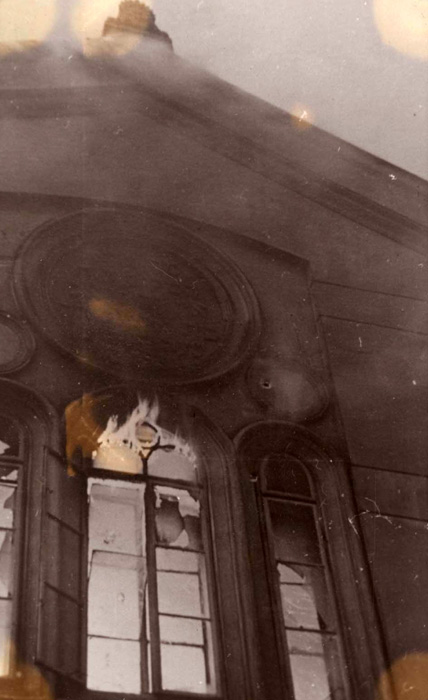
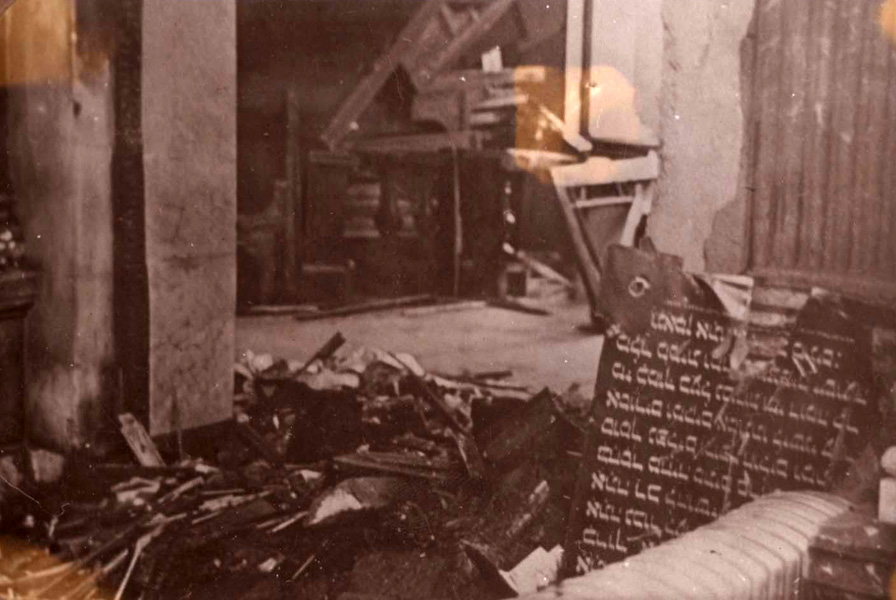
Between 4 and 6 a.m. units of the 89th and 11th SS Standarten began destroying synagogues and prayer houses. In some places, by the time they arrived the premises had already been wrecked by members of the SA, the Hitler Youth and local Nazi organisations. A special report of 10 November states that hand grenades were used in the attacks, after which furniture and the interior fittings of the buildings were set on fire.
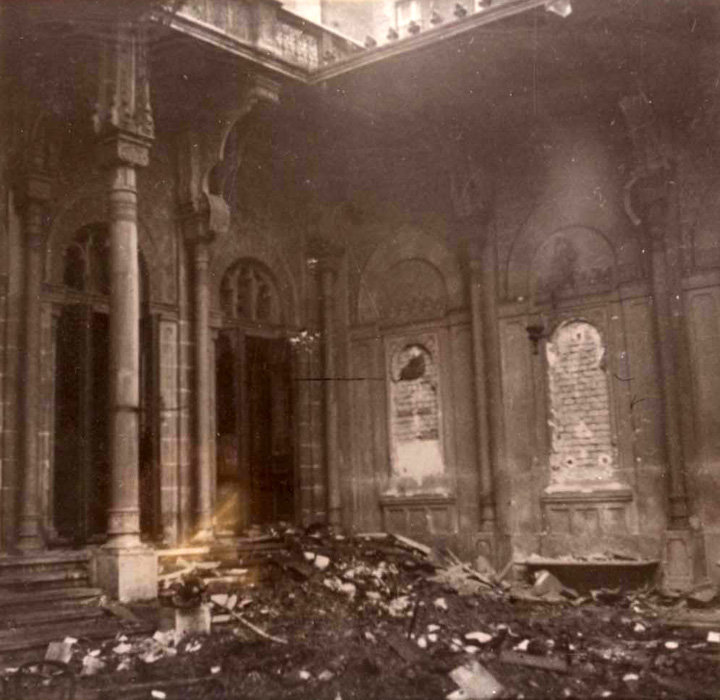
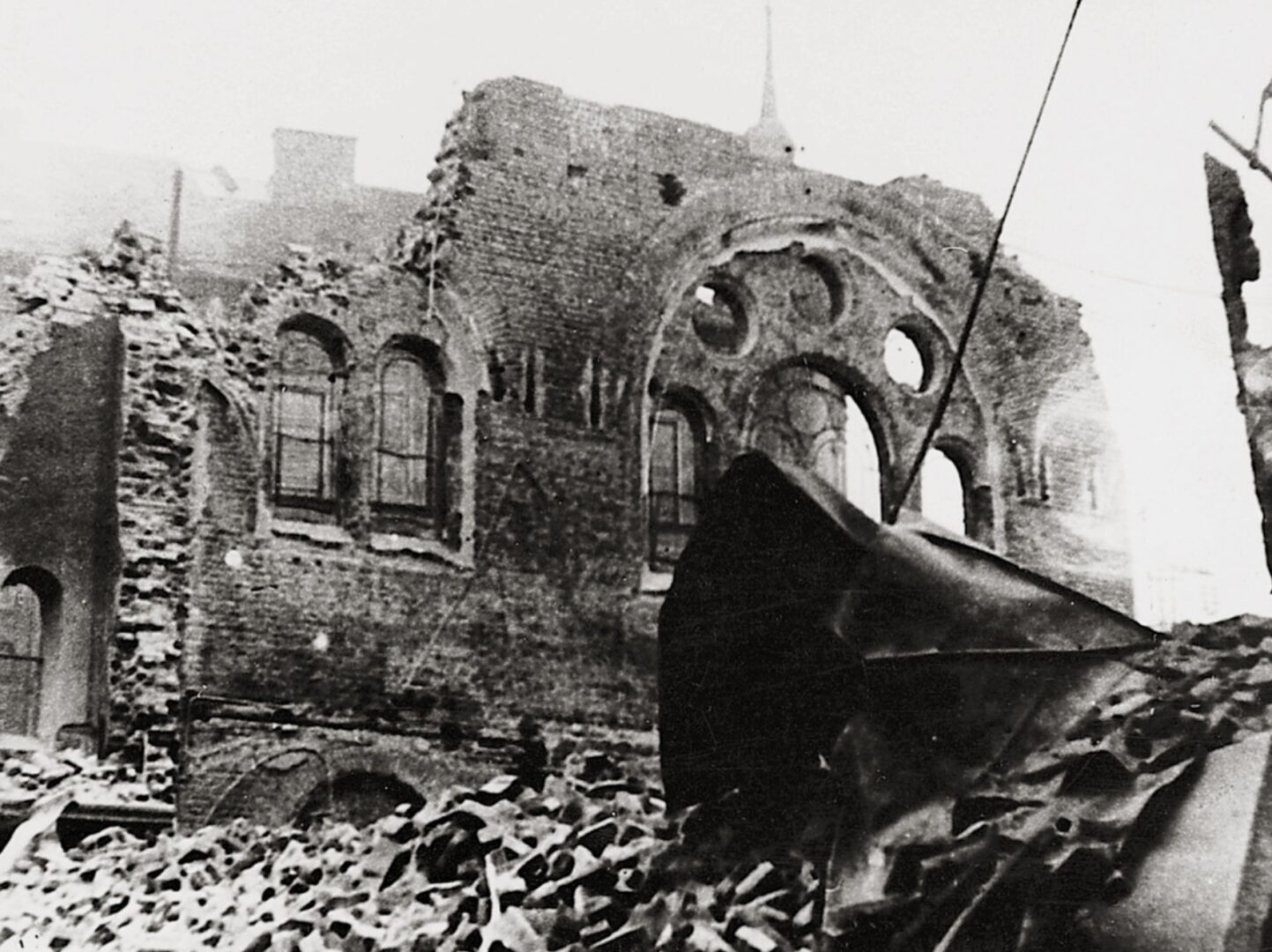
One of the destroyed sites was the large temple in the 2nd district, on Tempelgasse, built in the 19th century and regarded as the most important Jewish religious building in Vienna. It was set on fire and destroyed, and its ruins remained on the spot for several more years. In the 3rd district, at Untere Viaduktgasse 13, the synagogue of the Beth Hachneseth society, which had existed since the 1870s, was wrecked. It stood in the inner courtyard of a residential building and was designed for roughly 120 people. The building itself partly survived and was later used for other purposes. Today a memorial marker stands in front of the house. In the 20th district, at Kluckygasse 11, the Brigittenauer Tempel was destroyed, built around 1900 to a design by the architect Jakob Gartner. The surviving documents make it possible to reconstruct especially precisely the fire at the synagogue at Schopenhauerstraße 39 in the 18th district. The temple, built in 1888–1889 to a design by Jakob Modern, was set on fire on 10 November. According to the records of the Vienna Fire Brigade, the firefighters protected the neighbouring residential buildings, allowing the synagogue itself to go on burning. Work continued until 14:30 the following day, 11 November, and on 12 November fire broke out again in the ruins.
The city’s main synagogue, the Stadttempel at Seitenstettengasse 4 in the 1st district, escaped being set on fire. The synagogue, built in 1826, stood within dense urban development, so the fire could have spread to neighbouring houses and to the archive premises of the Jewish community. The Nazi authorities ordered that the building not be set alight. Its interior was wrecked, but the synagogue itself survived and is still in use today.
Attacks also took place in Margareten, Mariahilf, Josefstadt, Ottakring, Hernals and other districts of the capital. According to the Vienna City and State Archive, until November 1938 the city had 6 large Jewish temples, 18 synagogues of religious societies and 78 prayer houses. During the pogroms, 42 synagogues and prayer houses were destroyed, and many of the rest were looted and desecrated.
By the morning of 10 November, fires and street attacks had spread through different parts of the city. In some districts schools were closed so that young people could take part in Nazi actions. Reich Commissioner Josef Bürckel reported in his account of 18 November that by midday the fire service could no longer cope with the number of calls. According to him, about 40 buildings and premises were on fire at the same time. The firefighters mostly protected neighbouring buildings, while the synagogues themselves continued to burn.
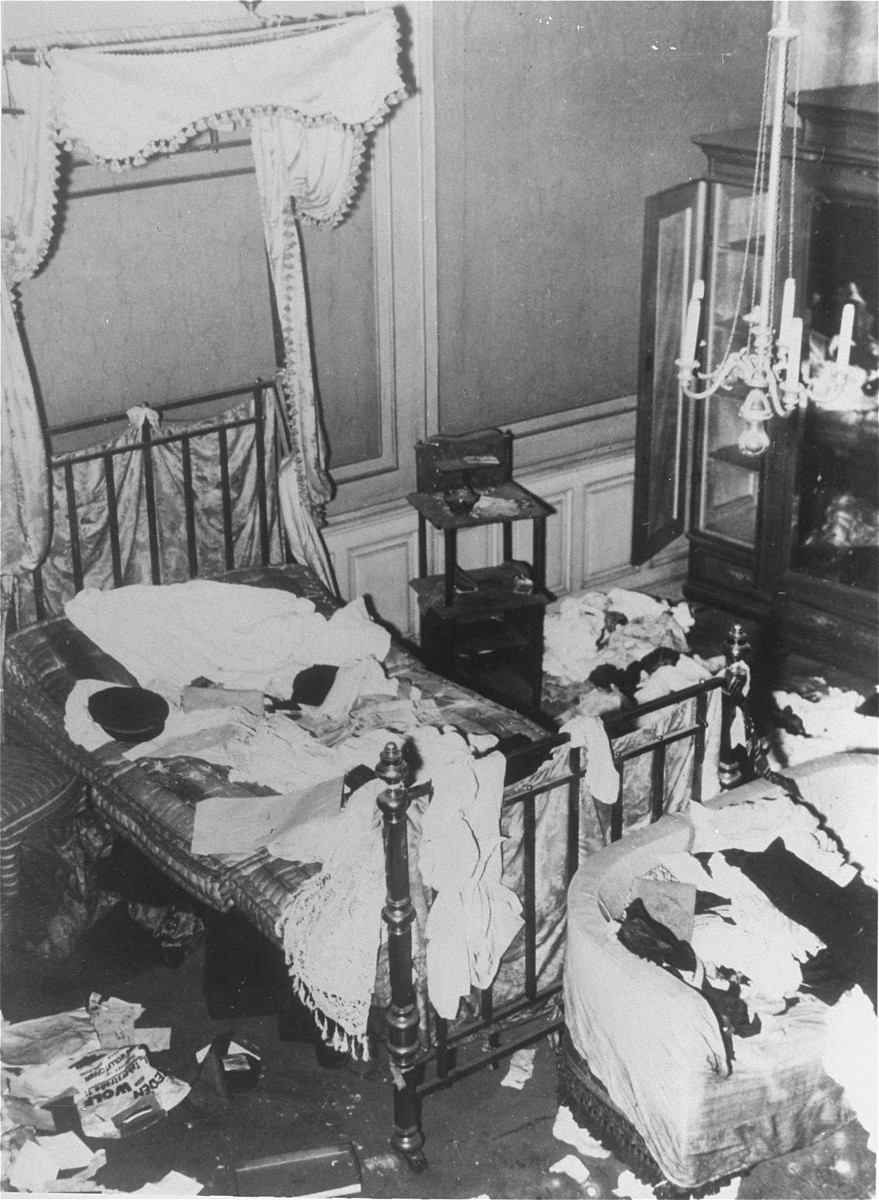
On the streets the windows of Jewish shops were smashed. The attackers broke into shops and homes, destroyed furniture, and carried off goods and valuables. People were beaten, insulted and detained. Local party organisations had information about which businesses and flats belonged to Jews, so the attacks were often accompanied by the immediate seizure of property.
Formally, Nazi orders forbade unauthorised looting of shops, but the authorities sought to control the confiscation of property. Bürckel’s report mentioned seized jewellery, gold, silver and other valuables. Some of the property was put into storage, and the remaining goods were to be channelled into trade later.
According to the report of the Vienna branch of the Security Service of 18 November, about 4,038 Jewish businesses were closed in the city during the pogroms. In the 1st district alone, 1,950 flats were forcibly cleared of their previous tenants. Even the authors of the document, who belonged to the Nazi repressive apparatus, noted numerous cases of beatings, destruction and arbitrary appropriation of property. Their remarks, however, concerned mainly breaches of discipline and the loss of control over the plundering of property. At the same time, mass arrests of Jewish men were under way. They were detained at home, in the streets and at their workplaces, beaten, and taken to police institutions without any individual charges of having committed a crime.
Because the usual places of detention quickly filled up, temporary assembly points and improvised jails, known as Notarreste, began to be set up in Vienna. They were located, among other places, at the Sofiensäle, and on Pramergasse, Karajangasse and Kenyongasse. A former convent school at Kenyongasse 4 housed one of the largest temporary places of detention, through which, according to surviving information, more than 2,000 arrested Jews passed. The detainees were made to perform exhausting physical exercises and were brutally beaten. Detailed testimony of what happened survives in the memoirs of Ernst Benedikt, the former publisher and editor-in-chief of the Viennese newspaper Neue Freie Presse. He described the violence and abuse in the temporary places of detention on Pramergasse and Kenyongasse. His memoirs are held in the Documentation Centre of Austrian Resistance.
Another important piece of evidence is the diary of 12-year-old Viennese schoolboy Harry Kranner, later known as Harry Fiss. He began keeping it on 4 November 1938, intending to describe his family’s preparations for emigration, but within a few days his diary had turned into a direct record of the pogroms. During the attacks the Nazis searched the family’s flat. The boy’s stepfather, Emil Fichmann, was forced to wash the pavement in front of the house, and his uncle, Arthur Singer, was arrested and sent to the Dachau concentration camp. The diary is preserved in the collection of the Leo Baeck Institute.
In the afternoon of 10 November the Nazi leadership ordered an end to the mass street attacks. Joseph Goebbels announced that further measures against Jews would be carried out by legislative means. However, the order did not stop the violence in Vienna. Police reports contain accounts of attacks, looting and abuse on 12, 13, 14, 15, 16 and 17 November. In his report of 18 November, Bürckel claimed that the mass disorder had finally ceased on the evening of 15 November, although individual police documents recorded new cases of persecution even later.
According to the Documentation Centre of Austrian Resistance, 6,547 Jews were detained during the Viennese November pogroms, of whom almost 4,000 were sent to the Dachau concentration camp. By 17 November about 2,000 of those arrested were still in Vienna’s places of detention. Dozens of people were killed during the pogroms; later, some of the victims died of their injuries or the consequences of detention, and others took their own lives.
On 12 November 1938 a meeting chaired by Hermann Göring was held in Berlin, devoted to the economic consequences of the pogroms and to further measures against the Jewish population. As a result, a collective indemnity of one billion Reichsmarks was imposed on the Jews, presented as punishment for the murder of the German diplomat in Paris. Jewish owners were required to pay for the repair of damaged businesses and flats themselves, and insurance payments for destroyed property were to be confiscated for the benefit of the state. Another decree banned Jews, from 1 January 1939, from independent retail trade, crafts and a number of other types of business activity. In Vienna, city institutions demanded that Jewish religious organisations pay for the removal of building rubble and the demolition of the destroyed synagogues. The corresponding orders survive in the documents of the Vienna City and State Archive.
When you analyse all these historical events, you can’t help asking: who is to blame and what is to be done? It is easiest to blame individual people, ordinary residents, or even an entire city for hatred. But as someone who has worked in sales and marketing for 20 years, I know very well how successful businesses built on human fears and emotions can be. Evoking these feelings in each of us is much easier than it seems. Sometimes it is enough to repeat even the craziest idea over and over for people to begin, in time, to believe it. Just look at how the Kremlin is now trying to create hatred towards the once-close Ukrainian people. And any state can pull this off.
Today too many people, organisations and political forces have not only mastered the tools of propaganda but also gained the means to spread it far more effectively than the Nazis did in Germany. Modern technology allows people to find like-minded others and unite in information bubbles at a speed that would have been hard to imagine even 30 or 50 years ago.
As a result, we hear one another less and less, and sometimes we don’t even feel any desire to understand another point of view. Sometimes it seems that a person is practically impossible to persuade, because instead of his own thoughts and arguments he operates with memorised slogans. And someone who speaks in stock phrases often no longer thinks about the meaning of what he is saying.
And yet I don’t want to be a pessimist. I have always been someone who looks at life as optimistically as possible, and I continue to believe that a lot depends on each of us. It seems to me that it is important to learn to recognise the complexity of the questions we face, to accept that different views exist, and to look for ways to resolve even the hardest contradictions, to look for compromises based on love and mutual support, not on fear, killing or religious intolerance. Perhaps this is exactly what will help us avoid repeating the mistakes of the past, the consequences of which in today’s world could be even more terrible.
You may also like these articles:
- Sziget 2026 — Part 2. Day 0
- The History of the Austrian Town of Straßburg
- An Emigrant’s Observations: How to Improve Your Chances of Getting Lucky as an Emigrant
- Lise Meitner: An Outstanding Researcher of the 20th Century from Austria
- Sziget 2026 — Part 1. The Beginning
- The History of the Austrian Town of Peuerbach
- An Emigrant’s Observations: My Strongest Motivation in My New Country Is the Fear of Returning to My Homeland
- New Restaurants in Vienna Opening in November 2026
- Josef Petzval: The Austro-Hungarian Mathematician Who Was Ahead of His Time
- Photo Report from Almost-Summer Malaga 2026
- The History of the Austrian Town of Bad Aussee
- Anti-Jewish Pogroms in Vienna, 9–10 November 1938
- The Most Beautiful Christmas Markets in Vienna
- Andrea Bocelli Live in Vienna: A Look Back at the Concert
- An Emigrant’s Observations: What “Home” Means After Nine Years Abroad
- An Emigrant’s Observations: My Nine Years in Austria
- An Emigrant’s Observations: Reverse Culture Shock
- My Beloved Vienna: By the Numbers, Not Just from the Heart
- An Emigrant’s Observations: A Fresh Look at the Exhausting Process of Adapting to Another Country
- Photo Report from Donauinselfest 2026. Part Two: Giant Rooks and Another Evening on the Island
- Photo Report from Donauinselfest 2026. Part One: My Ugly Clementine
- An Emigrant’s Observations: The Russian Language Without the “Russian World”
- Marilyn Manson Live in Vienna: A Look Back at the Concert
- An Emigrant’s Observations: Feeling Guilty About My Good Life
- An Emigrant’s Observations: What Surprises Me About the Austrian Attitude to Beer
- LP Live in Vienna: A Look Back at the Concert
- An Emigrant’s Observations: Anti-Putinism and the Imperial Lens
- An Emigrant’s Observation: How Big Is Our Small World?
- An Emigrant’s Observation: How Difficult Is It to Make New Friends?
- It’s My Birthday Today!
- My Life in Austria: July 2026
- An Emigrant’s Observations: My Toxic Homeland —Yesterday, Today and Tomorrow
- Ricchi e Poveri Live in Vienna: A Night of Music and Memories
- An Emigrant’s Observations: Simple Ways to Support Your Emotional Well-Being
- Eisenstadt in Pictures: A Day in a Small Austrian City
- Exploring Vienna’s Neubaugasse Flea Market
- Sofia Isella Live in Vienna: A Concert Review
- An Emigrant’s Observations: When Mistakes Become Toxic While Adapting
- An Emigrant’s Observation: Extreme Heat in Europe and Austria in 2026
- My Emigration to Austria: June 2026 Recap
About the project:
My name is Anatoly, and I am the author of Emigrants.life. In 2017, my family and I emigrated from Krasnodar to Austria. My wife and I work in marketing, and we created Emigrants.life to help people who are thinking about moving abroad.
Emigrants.life publishes daily news about life and everyday matters in Austria and Europe. Follow us on Facebook, Instagram and Twitter, or join our Russian-language Telegram channel.