
Julia and I have been living in Austria for nine years now, after moving here from Krasnodar. During that time, concerts have become a regular part of our life. In this country, it is easy to get to them, comfortable to be among the crowd, and simple to get home afterwards. We have already seen many musicians whom we previously knew mainly from recordings, although some long-standing wishes were still waiting to come true. One of them finally did on 21 July 2026, when I went to see Marilyn Manson at METAStadt in Vienna. Julia decided to skip this evening, so I went alone to discover a venue that was new to me.

At my first university, there was a professor named Petrovsky — a talented man with whom I got along very well. I was around 20, and he was, as far as I remember, somewhere between 50 and 60. He turned out to be a huge Marilyn Manson fan. This was the 2000s, and by then I was already prepared to forgive an adult man quite a lot if he listened to bands like DDT or Mashina Vremeni. But a university professor who was passionate about Manson went far beyond what I thought was possible.

Among adults at the time, some kind of criminal underworld music was mostly fashionable, which for some reason they called chanson. Marilyn Manson, whom I knew from videos on MTV Russia, became someone whose work I wanted to look at more closely thanks to a professor from a university in Kuban.

I can honestly say that I never became a devoted fan who knew the entire discography, but I was drawn to the beauty of the music. Despite the performer’s provocative appearance, there was a great deal of melody in it, something easy to miss if you looked only at the makeup and stage antics. The professor, it seemed to me, was much freer than many of the adults around me in his attitude toward what someone his age was supposedly meant to listen to.
Marilyn Manson is also connected in my mind with an important wider context. I grew up in an environment where a complete stranger could slap a child around the head and then simply carry on with what they were doing, completely convinced they were right. Cruelty was often explained as discipline, while male strength was readily associated with the ability to hit someone. Against that background, Manson seemed to me like a person mocking all that seriousness.

His deliberately aggressive image felt grotesque, almost like a parody of the rules we lived under. What seemed particularly strange was the outrage of adults who found the source of teenage violence in music and computer games. That was how it was explained in my childhood; now the internet and almost anything else gets blamed, as long as people do not have to look at themselves. Back then, we laughed at Jackass on MTV and tried to accept the unfairness of the adult world, whose representatives were, at the time, the same age that we are today.

That is why I also felt close to the conversation Michael Moore started in Bowling for Columbine, which featured Manson. The film was released in 2002 and explored American gun culture and violence after the school massacre. I recognised in that discussion the familiar adult habit of looking for someone to blame somewhere outside their own home. A lot has changed since then in attitudes toward children and violence, and I like those changes. It makes me remember even more clearly why a person with such a frightening appearance could once inspire trust in me.

Brian Warner was born in 1969 in Canton, Ohio, attended a Christian school, and before starting his music career wrote about musicians for a magazine in Florida. The band appeared in the early 1990s, along with a stage name that combined Marilyn Monroe with the criminal Charles Manson. Even in that combination, you can already see an interest in American fame, which can be given just as eagerly to an object of universal admiration as to someone who inspires horror. Trent Reznor of Nine Inch Nails helped the band develop and released its debut album on his label.
Manson knew how to change his appearance so completely that it became part of the conversation about the music itself. The androgynous image on the cover of Mechanical Animals stood in sharp contrast to the familiar image of the muscular rock hero. There was something artificial and vulnerable about it, something capable of repelling you and drawing your attention at the same time. This kind of artist gave people plenty to discuss before they even started paying attention to the lyrics.
The Beautiful People is a good place to start if you want to understand his satire. Manson connected the song with the cult of beauty and the social demands people are expected to meet in order to be accepted. In this reading, the “beautiful people” form a privileged circle that feels entitled to decide everyone else’s value. The brutality of the song becomes easier to understand when you hear in it the language of superiority pushed to an extreme. Manson himself explained that he used the appeal of glamour while at the same time opposing its power.
In The Dope Show, addiction takes on a different meaning. When explaining the idea behind the video, Manson spoke about people who fall under the influence of fame, money, and power, which work like drugs. You can hear a mockery of celebrity culture here, where a person becomes addicted to other people’s attention and increasingly needs the next dose. Behind the provocative title lies a very recognisable human story. To understand it, knowing English can sometimes change your impression of a song far more than learning about yet another scandal surrounding the artist.
In recent years, Manson’s name has often appeared in the news in connection with allegations of abuse. In 2021, Evan Rachel Wood and other women publicly came forward; the musician denied the allegations, while his record label and agency ended their cooperation with him. In January 2025, the Los Angeles County District Attorney’s Office declined to file criminal charges after a four-year investigation: the statute of limitations had expired for the alleged domestic violence incidents, while prosecutors concluded that the sexual assault allegations could not be proven beyond a reasonable doubt. Civil cases are continuing; the lawsuit filed by former assistant Ashley Walters is scheduled for trial in November 2027.
Manson returned to live performances in August 2024 after a break of almost five years. He later spoke publicly about his sobriety: in January 2025, he said that the following month would mark four years since he had stopped using drugs and alcohol. Watching his return, I noticed how much his appearance had changed. The Vienna concert gave me a chance to see for myself how he now carried himself on stage and what remained of the energy I remembered from his older performances.
The tour was called One Assassination Under God, after the 2024 album. The Vienna show took place between its two chapters: Chapter 2 was scheduled for release on 14 August 2026, while Manson was already performing the new song Exit Wound at concerts. The published schedule for the July European leg included fourteen cities in eleven countries.
According to the organisers, around 7,500 people came to METAStadt. Kronen Zeitung reviewer Robert Fröwein noted Manson’s strong vocal and physical condition and the professionalism of the performance, although he complained about its length — around eighty minutes.

My own impression of the duration was different: the evening felt full enough for me to leave with the sense that I had experienced a complete concert.
METAStadt turned out to be a pleasant discovery. The concert venue occupies the grounds of a former industrial complex where old brick buildings have been preserved. I like places like this, and I quickly felt comfortable there. Getting there by suburban train was easy, and at the venue itself I managed to find a place close to the stage.
I also remembered the merchandise featuring reproductions of Manson’s paintings. The items looked expressive and completely in keeping with his style. His painting deserves separate attention. Interestingly, Vienna had already hosted his artwork long before this concert: in the summer of 2010, Kunsthalle Wien at Karlsplatz exhibited Manson’s watercolours together with short films by David Lynch.

There were many people from my generation and older in the audience, although there were plenty of younger people as well. Some came in fantastic outfits inspired by Manson’s image, and the crowd suited the evening perfectly. Security staff near the stage chatted with people, laughed, and offered free earplugs to those standing at the front.

People standing nearby were also very friendly toward one another. You could tell someone that you were going to the toilet or to get a beer and then return to your place; I saw many people doing exactly that. In general, the audience was very different from the one at the Sofia Isella concert I wrote about earlier.

At the same time, I rarely see so many very drunk people at Austrian concerts. Seeing someone with a beer in their hand here stopped surprising me a long time ago, but this time there were men who could barely stay on their feet. I also remember a girl who had come with her parents: when she had to be taken out of the fan zone, her mother followed her. The medical staff and venue employees worked efficiently, helping people who became unwell and using stretchers when necessary. All of this was happening alongside the concert and remained part of what was, overall, a very well-organised evening. Still, it was a little surprising to me.

The opening act was VOWWS, and I liked them — an energetic start that suited the evening. They had quite a few good songs, and what was especially surprising to me was that some people had come specifically to see them. I did not even know who the opening act would be.
When Manson came on stage, the first thing that struck me was his energy. At fifty-seven, he moved and sang with such intensity that I could not help thinking about how much physical strength a performance like that must require. The sound was comfortable even next to the speaker where I was standing, and being close to the stage made it easy to see what was happening and record individual moments.
Manson performed all of his main hits, as well as his newer songs, exactly as they should be performed. At the same time, the show itself was fairly modest compared with the ways musicians try to surprise their fans today. But he still had that mysterious emptiness of a dark abandoned house where the strangest things are happening. Maybe that is only my perception, but it brought back exactly the atmosphere I remember from films and music videos of the early 2000s.
There were several epic moments during the concert. During Personal Jesus, a guy dressed as Jesus set off on a journey above the crowd, carried by the hands of other spectators. Security ended his trip fairly quickly, but he looked happy. And honestly, it was really cool!
Manson also provided the necessary amount of spectacle himself: during Tourniquet, he came onto the stage on stilts. At fifty-seven, I would probably think twice about how not to fall off them, but Marilyn looked quite confident up there.
Another memorable moment came with the closing song, If I Was Your Vampire. While Marilyn Manson sang it into a microphone shaped like a large knife, artificial snow fell around him. The snow stayed in my memory in particular — a beautiful ending to a vivid performance, and exactly the kind of moment that had once made me want to stand among this crowd myself.
After the concert, people were directed along different routes depending on how they planned to leave. Taxis stood in a line, with passengers approaching them one by one. On the way to the suburban train, staff controlled the flow of people and occasionally stopped it so that too many passengers would not gather on the platform at once. The first train became extremely crowded; I waited for the next one and entered the carriage without any problem.

I got home comfortably, and that part of the evening also stayed with me. After spending several hours near the stage, it is nice to discover that someone has thought about how the audience will leave and all you have to do is follow the route that has been arranged for you. Moments like this make me especially happy to live in Vienna.
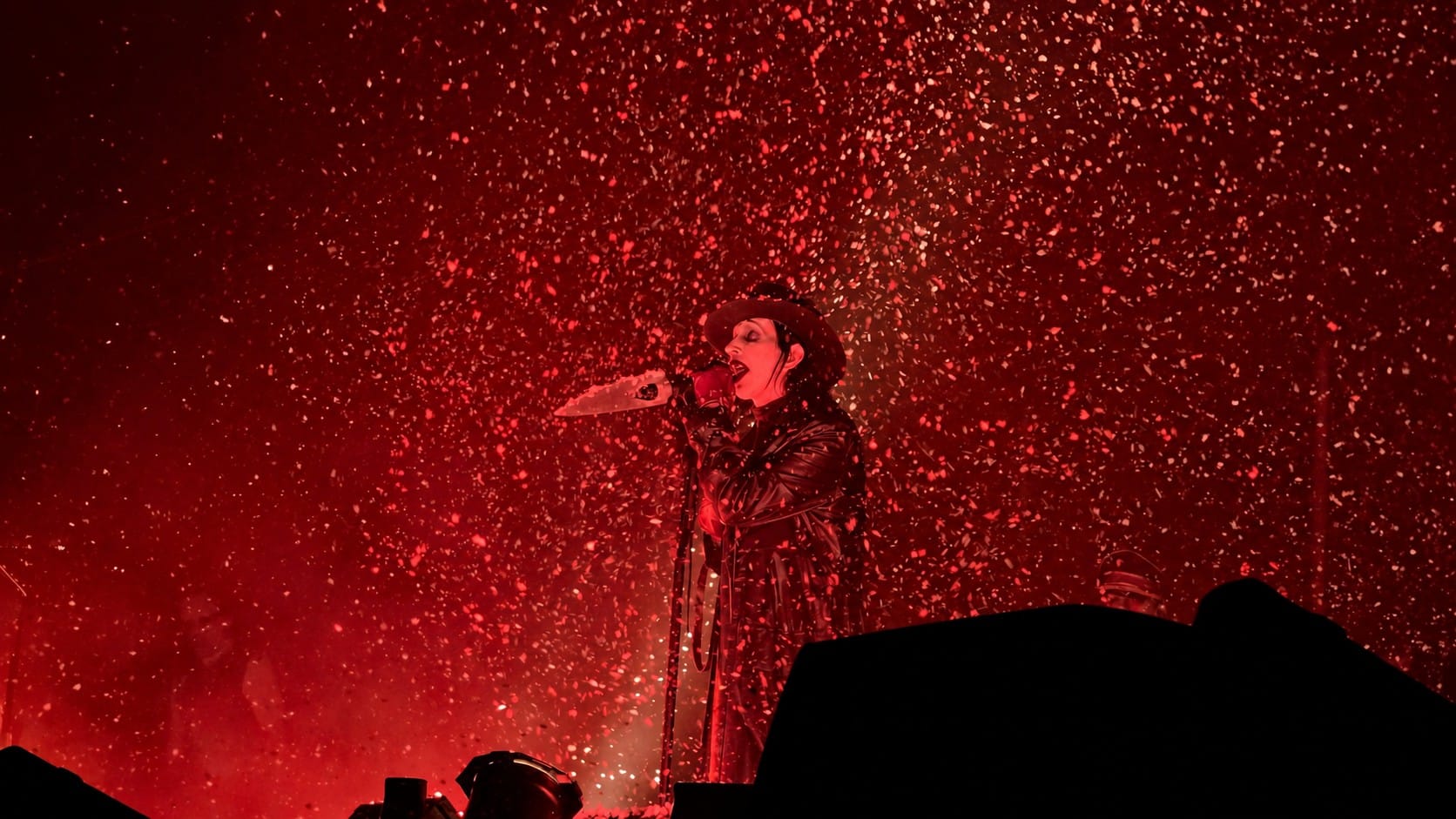
The concert itself was very good and exactly what I had imagined. Passionate fans, music, safety, and a living legend whom I was finally able to see and hear — and, in my own way, send greetings to from Professor Petrovsky, a person from my youth, which somehow feels as though it was only yesterday.

You may also like these articles:
- An Emigrant’s Observations: What “Home” Means After Nine Years Abroad
- An Emigrant’s Observations: My Nine Years in Austria
- An Emigrant’s Observations: Reverse Culture Shock
- My Beloved Vienna: By the Numbers, Not Just from the Heart
- An Emigrant’s Observations: A Fresh Look at the Exhausting Process of Adapting to Another Country
- Photo Report from Donauinselfest 2026. Part Two: Giant Rooks and Another Evening on the Island
- Photo Report from Donauinselfest 2026. Part One: My Ugly Clementine
- An Emigrant’s Observations: The Russian Language Without the “Russian World”
- Marilyn Manson Live in Vienna: A Look Back at the Concert
- An Emigrant’s Observations: Feeling Guilty About My Good Life
- An Emigrant’s Observations: What Surprises Me About the Austrian Attitude to Beer
- LP Live in Vienna: A Look Back at the Concert
- An Emigrant’s Observations: Anti-Putinism and the Imperial Lens
- An Emigrant’s Observation: How Big Is Our Small World?
- An Emigrant’s Observation: How Difficult Is It to Make New Friends?
- It’s My Birthday Today!
- My Life in Austria: July 2026
- An Emigrant’s Observations: My Toxic Homeland —Yesterday, Today and Tomorrow
- Ricchi e Poveri Live in Vienna: A Night of Music and Memories
- An Emigrant’s Observations: Simple Ways to Support Your Emotional Well-Being
- Eisenstadt in Pictures: A Day in a Small Austrian City
- Exploring Vienna’s Neubaugasse Flea Market
- Sofia Isella Live in Vienna: A Concert Review
- An Emigrant’s Observations: When Mistakes Become Toxic While Adapting
- An Emigrant’s Observation: Extreme Heat in Europe and Austria in 2026
- My Emigration to Austria: June 2026 Recap