
“All Russians, whether they still live in Russia or have emigrated from it, are guilty of this terrible war” — this is one way this article could be interpreted before anyone even reads the text itself. I can only say that every person’s perception is a deeply personal system of values and judgments, and only that person — the reader — can be responsible for it. In today’s article, I want to raise a much more difficult subject for me. It is about the ability to reflect, to look at yourself from the outside, and to genuinely want to do everything possible to rid yourself of an imperial way of seeing both yourself and the world. First of all, this article is about me, my thoughts and conclusions. But it is also about my own observations of other Russian-speaking compatriots who now live in very different countries and still retain some features of that same imperial “Russian world,” which, like very strong alcohol, changes your perception of reality.
Epigraph: “They took down the portraits, but left the nails in the wall”
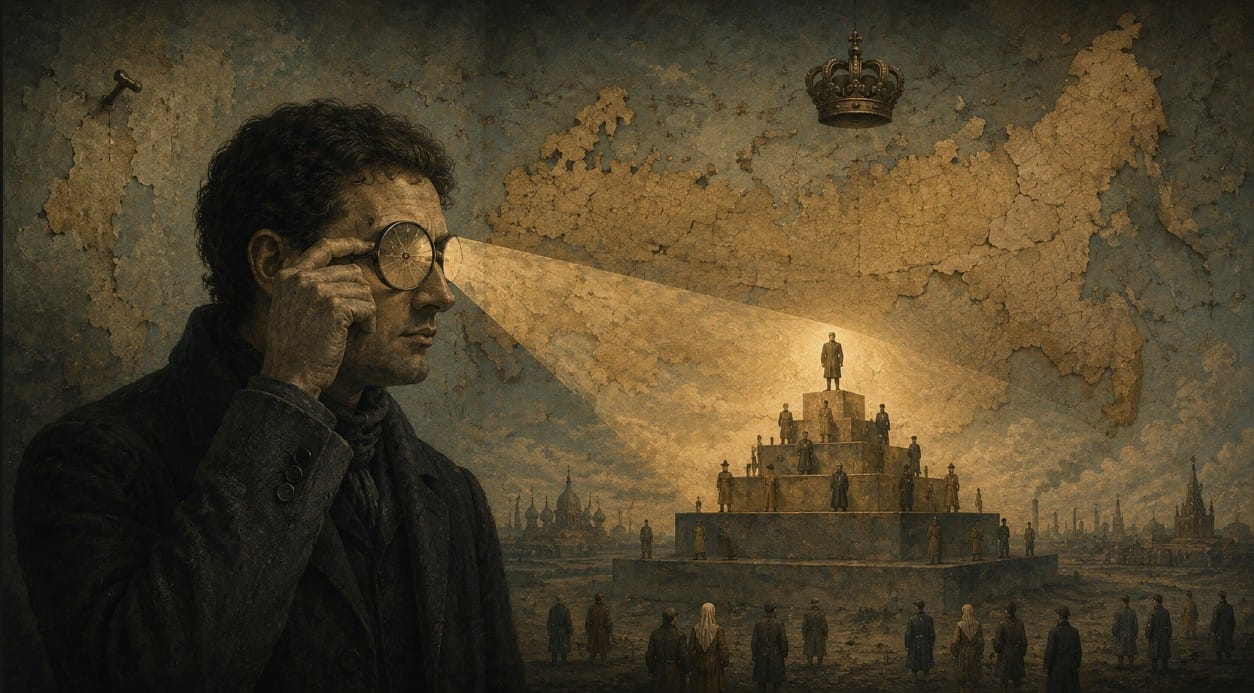
I quite often talk to Russians who have long opposed Putin, condemned the war in Ukraine, read independent media, helped political prisoners, and generally consider themselves liberal and democratic. Their age and ethnicity, income and place of residence can be completely different. And yet, in conversations with them, I periodically notice things that surprise me at first. Later, I realise that the same character traits or ways of seeing life may also exist in me.
For example, someone can spend an hour talking about the crimes of Putin’s regime and then calmly say, “Well, you know what Adyghe people/Armenians/Jews are like.” Or they call people from Kuban “kubanoids.” They can be outraged by Russian chauvinism and, a few minutes later, speak condescendingly about the peoples of the Caucasus or about the Khanty and Mansi, saying that “they don’t need museums because it’s just a waste of public money! There isn’t really much culture there anyway.”
And how did people from Russia begin to behave in the independent countries of the Caucasus that accepted them and gave them a chance to live there, at least for some time? How much arrogance did I see online over the fact that someone from Russia had to deal with “some paperwork” in Kazakhstan, Georgia, or Armenia, where not everyone speaks perfect Russian? I doubt the Russian dictator made them behave that way.
There are even people who practically radiate hatred of Putin, support Ukraine, and at the same time almost demand that a Ukrainian speak Russian to them, saying that “we are all one people.” It sounds like mockery.
The question itself already assumes a certain system of coordinates and a kind of hierarchy. The Russian language remains at the centre, while the Ukrainian is somehow expected to explain their attitude toward this issue during a war. And every time, the same question comes to my mind. How far does a person really move away from Putin’s Russia if Putin already disgusts them, while the familiar image of a great Russia still feels completely natural?
I am increasingly inclined to think that anti-Putinism by itself says only something about a person’s attitude toward one man and his regime. It does not automatically change anything in their ideas about the state, its size, its structure, the relationship between the centre and the regions, Russian culture, or other peoples. You can hate the dictator and continue to love the empire as part of your own identity. Again, I am talking about situations in which people from Russia who oppose Putin and the war behaved in exactly the same way as the person they were opposing, without even noticing their own behaviour.
Crimea as an important test for me
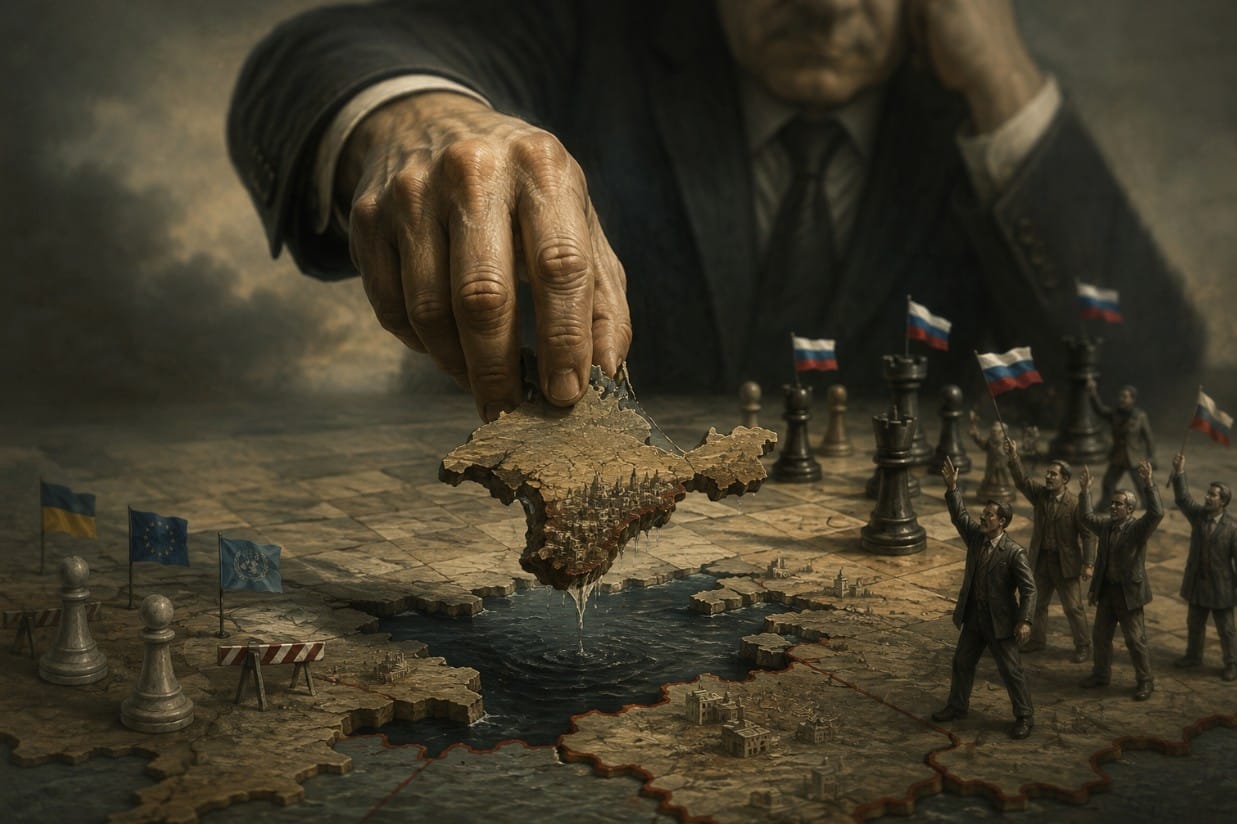
I felt this especially strongly in 2014, after the annexation of Crimea. The territory of a neighbouring state had been seized by force. Even then, this seemed extremely dangerous to me. If a state decides today that it can take someone else’s territory by force, tomorrow the same principle will inevitably be applied somewhere else. But for some people I knew who called themselves opposition supporters, it seemed perfectly normal to travel to Crimea after the annexation and “celebrate” it together with Putin.
I clearly remember how strange the reactions were even among people whom I considered part of the Russian opposition at the time. Boris Nemtsov was among those who immediately opposed the annexation and warned about its consequences. But many others tried somehow to combine criticism of Putin with the desire to keep Crimea under Russian control. Alexei Navalny’s position was particularly revealing to me. He acknowledged that Crimea had been seized in violation of international norms, but at the same time said that the peninsula would remain part of Russia for the foreseeable future and proposed holding another referendum. And this is where that internal conflict appears for me.
If a territory was seized illegally, why does Russia continue to be treated as the side that should decide its future? Why, even after acknowledging the violation itself, does the next step become looking for a way to keep what was acquired? That was when I first saw especially clearly that opposition to Putin and rejection of imperial logic exist separately from each other. But most importantly, I realised that only a few years earlier I myself had not understood why borders between the countries of the former Soviet Union were necessary at all.
A great Russia as a value in itself
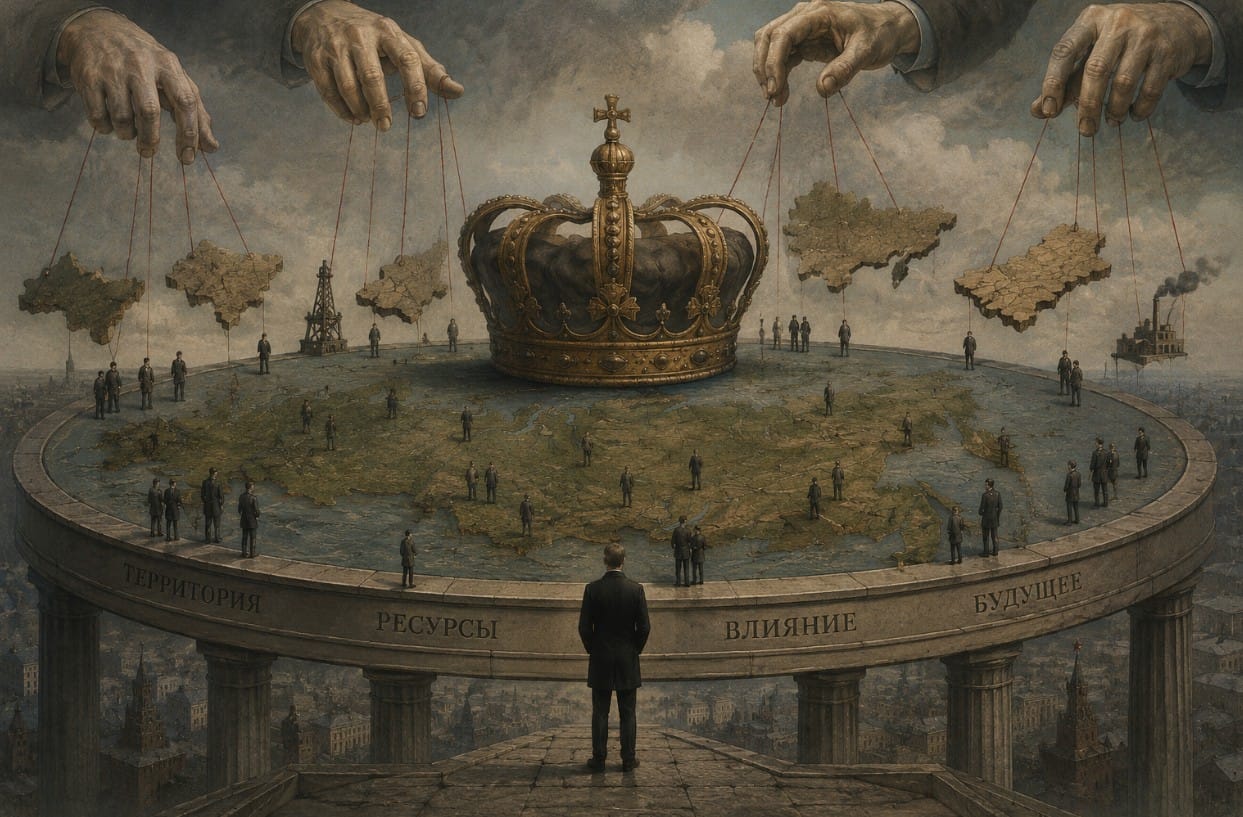
Try talking even to extremely liberal Russians about the possible breakup of Russia or about giving the regions much greater autonomy, and anxiety often appears almost immediately. “What do you mean, Russia could break apart?” The very idea is perceived almost as a threat.
And I always want to understand what exactly is so frightening about it. The fate of the people living in the regions? Possible conflicts? Economic consequences? Security issues? All of these things really matter and deserve a separate discussion. But sometimes there seems to be something else behind the anxiety — fear of the very idea that Russia could become smaller.
Why should the size of a state be seen as a virtue at all? Why should the number of square kilometres on a map give me, as a citizen, a greater sense of my own importance? Suppose the Khanty-Mansi Autonomous Okrug one day receives much greater autonomy. What exactly would a person living in Moscow lose because of that? Why are they so emotionally concerned about control over a region located thousands of kilometres away?
And this leads to an even more uncomfortable question. Are we really concerned about the well-being of the people who live there, or about the possibility that we might stop controlling the territory, its resources, and its political future? For some reason, such subjects still sound almost blasphemous. Russia’s territorial integrity is treated as an unquestionable good that no longer needs any explanation. As if the enormous size of the country were a value in itself, while any reduction automatically meant defeat and humiliation.
I think these are exactly the reactions we need to examine closely — both in other people and in ourselves. And this attitude easily extends beyond the borders of modern Russia. You can notice it in conversations about Armenia, Georgia, Azerbaijan, Kazakhstan, and other countries of the former empire and the Soviet Union. They are still often treated as a natural extension of Russian space — territories that formally exist separately but are somehow still expected to remain within Moscow’s special orbit.
Sometimes this appears in completely ordinary situations — in surprise when a neighbouring country follows its own policy, chooses different allies, or simply refuses to treat Russia’s interests as something it must automatically take into account. And then you can clearly see how deeply rooted the idea remains of a state that, as people once liked to say, “has no borders.”
It is especially interesting to observe how the possibility of Russia’s breakup is discussed even in independent and opposition media. People who have spent years criticising Putin, the war, repression, and the authoritarian system often talk about the breakup of the country almost as the main catastrophe that must be avoided at any cost. Sometimes it sounds literally like a warning to the viewer: if things go too far, Russia could fall apart. The word itself is already supposed to frighten you. And again, I find myself wondering why this argument works so effectively. Perhaps journalists understand their audience very well. They know that for a huge number of Russians, the thought of the country changing or becoming smaller feels almost physically painful. You can lose elections, you can lose economic growth, you can live for years with bad institutions, but the territorial question feels almost unbearable.
So it turns out that Putin can be rejected while the idea of a large and necessarily indivisible Russia remains almost completely unchanged. Perhaps this is exactly where one of the most difficult boundaries lies between anti-Putinism and a genuine rejection of imperial thinking. And here I want to ask the same question again. If we are really talking about a democratic Russia of the future, are we prepared to recognise for other countries and peoples the same right to self-determination that we demand for ourselves?
Moscow, which we have learned to see as normal
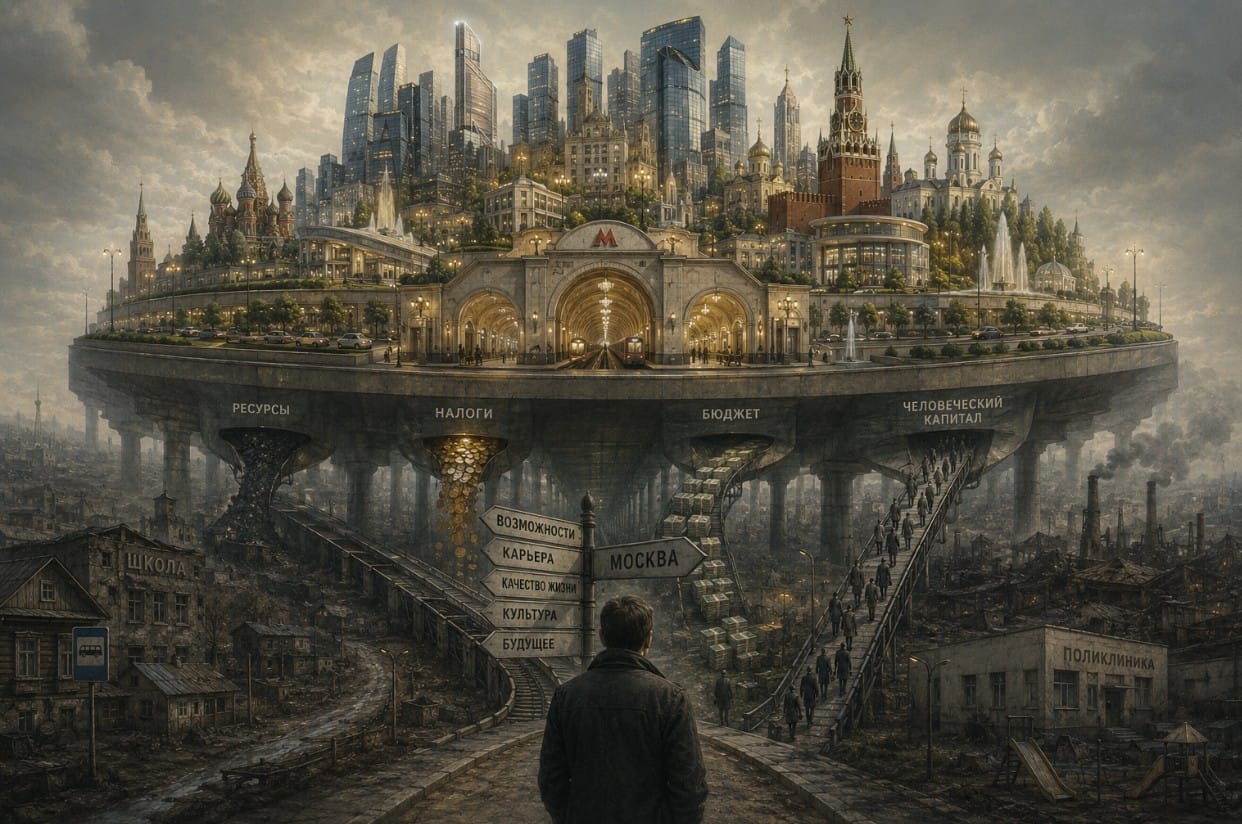
Something similar happens with Moscow. People come to the capital, look at the new metro stations, renovated streets, huge parks, road interchanges, and endless infrastructure projects, and they are genuinely impressed. And, to be fair, there really is plenty to admire.
But the next question comes up much less often. Why are so many resources concentrated here? Why should Moscow be so dramatically different from most Russian regions? Why has such a huge share of the country’s political, cultural, professional, and financial life been concentrated almost entirely in one city?
Beautiful Moscow metro stations easily become proof of Russia’s success as a whole. At the same time, the absence of comparable infrastructure in dozens of other cities is treated almost as the natural order of things. As if that is how it should be: new stations, granite, parks, and endless renovation here, while somewhere far away people can wait a little longer.
I grew up in Kuban and know this attitude of the centre toward the regions very well. It is convenient to mock the provinces a little, portray them as less educated, less modern, slightly ridiculous and backward. Then you can explain to the people living there that important decisions will still be made somewhere far away from them. Resources gradually move upwards, political autonomy shrinks, and in the end people are invited to come to Moscow and see how wonderful Russia is still capable of being.
The most surprising thing is that these realities often exist completely separately in people’s minds. Someone admires the capital and barely asks where such a huge difference between it and the rest of the country came from. These days, I increasingly want to connect one with the other.
Russia is sick with itself, but tries to cure others
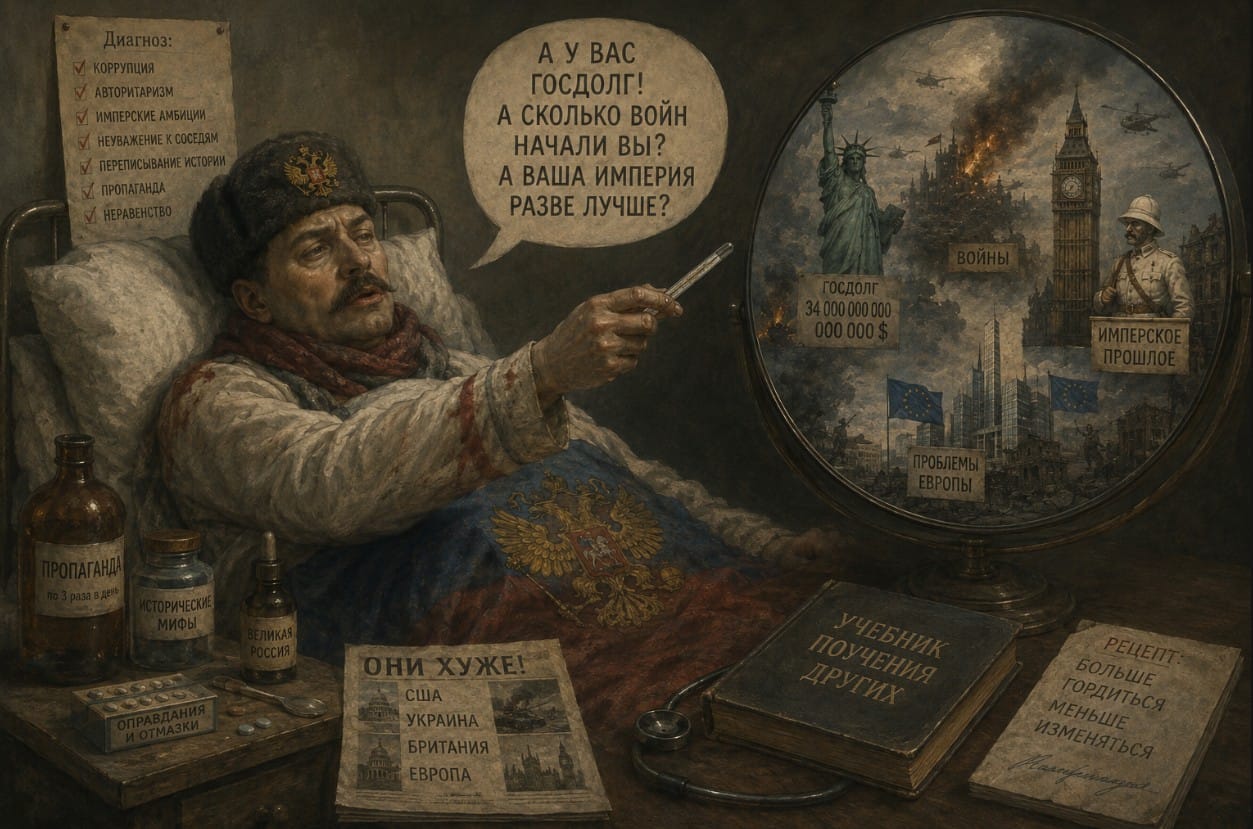
There is another habit I notice in almost every conversation about Russia’s problems. Start discussing something unpleasant, and within a few minutes another country will inevitably appear: America, Ukraine, Britain, all of Europe.
“Have you seen the US national debt?”
“How many wars has America started?”
“Was the British Empire any better?”
I used to think in roughly the same way. Then I began to notice more and more how strangely this argument works. If we are talking about Russia, why do I need America at that moment? How do the crimes of another country change what is happening in my own?
I was born in Russia, lived most of my life there, and grew up inside that culture. Many of my habits, reactions, and ways of seeing the world came from there as well. So I am much more interested in examining that experience, trying to understand where certain ideas about power, the state, neighbouring countries, and our own place in the world came from. Other people’s mistakes do not help with that at all. They only give us an opportunity to stop looking at ourselves for a while.
I think this is one of the most unpleasant features of such conversations. Instead of asking, “What happened to us, and why?” another question appears very quickly: “Are they really any better?”
But an adult conversation does not require a flawless conversation partner. I do not need a perfect American, British person, or Ukrainian in order to admit my own mistake. I do not need to prove that someone else is worse in order to recognise a problem on my own side.
I began to understand this especially clearly after moving to Austria. Here, you constantly encounter a society that also has a complicated imperial past, a difficult history, and many mistakes of its own. But modern Austrian life is hardly built around the need to justify that past every day or prove superiority over its neighbours.
Perhaps this is exactly what I sometimes miss in Russian conversations — the ability, even for a short time, to leave the rest of the world alone and look only at ourselves. Without America. Without Ukraine. Without Britain. Just Russia.
Greatness that someone always has to pay for
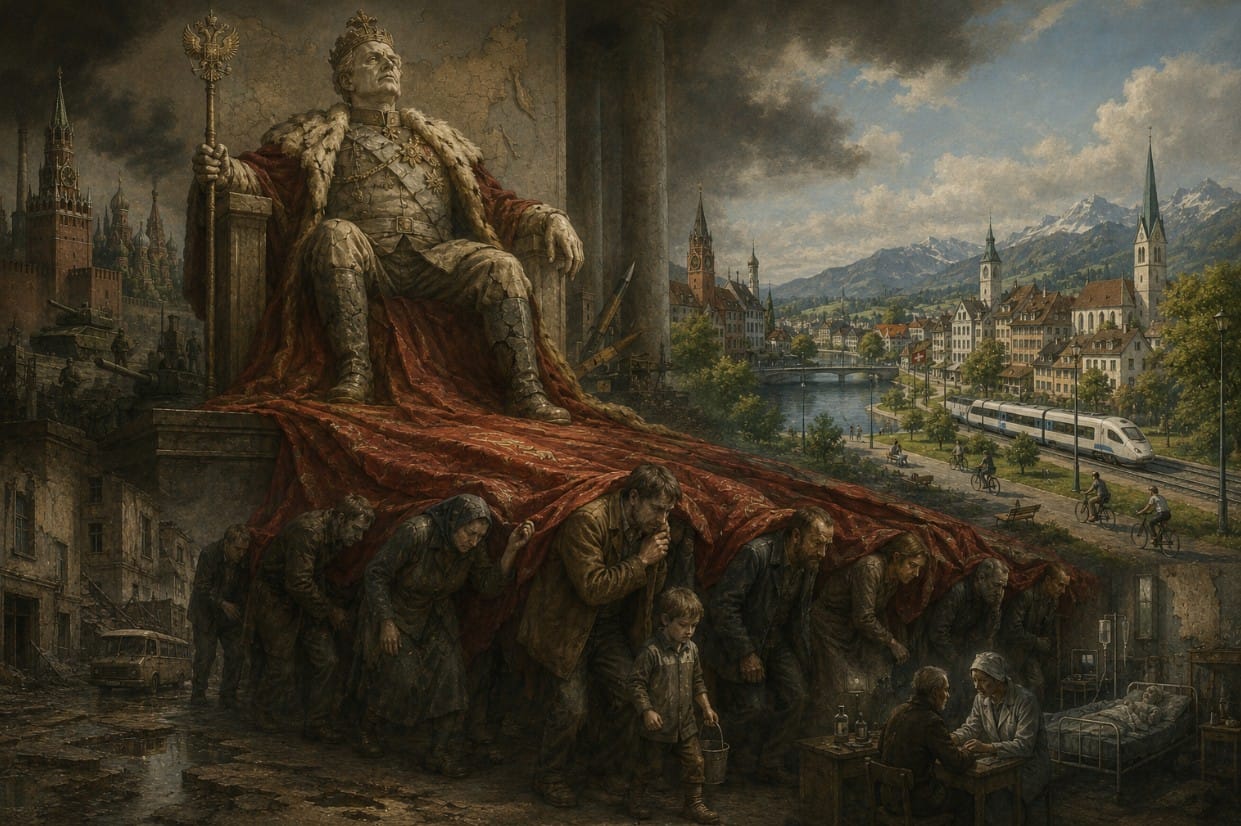
Zhvanetsky had a very precise joke about greatness and hunger. It is funny only until you start noticing how often state greatness is actually offered to people as compensation for completely ordinary deprivation. You can live for years with bad roads, weak healthcare, and crumbling infrastructure while taking pride in the fact that the country is enormous, powerful, and capable of forcing others to take it seriously. In such a system, a person’s everyday life seems to move into the background. What matters is that everything looks impressive on the map, the army is large, and everyone around feels fear or respect. “Russia is tied together around the perimeter,” while what is happening inside somehow seems unimportant.
At the same time, you only need to look at many small European countries to see a completely different model. Denmark, the Netherlands, Switzerland, and Norway do not try to prove their importance by the number of neighbouring countries they are able to influence. Their success is much more visible elsewhere — in the quality of roads, public transport, healthcare, education, safety, and ordinary urban life. And increasingly, I think this is where a very important dividing line lies. A state can spend its energy maintaining an image of its own greatness, or it can invest that energy in people’s lives.
In the Russian tradition, the first option has been chosen far too often. People were offered pride in their country instead of a more comfortable, peaceful, and safe everyday reality. And the most surprising thing is that many people accepted this bargain willingly. Perhaps that is why Russian greatness so often demands sacrifices. It always needs someone to pay for it with poverty, time, safety, or the future.
A small empire inside every everyday decision
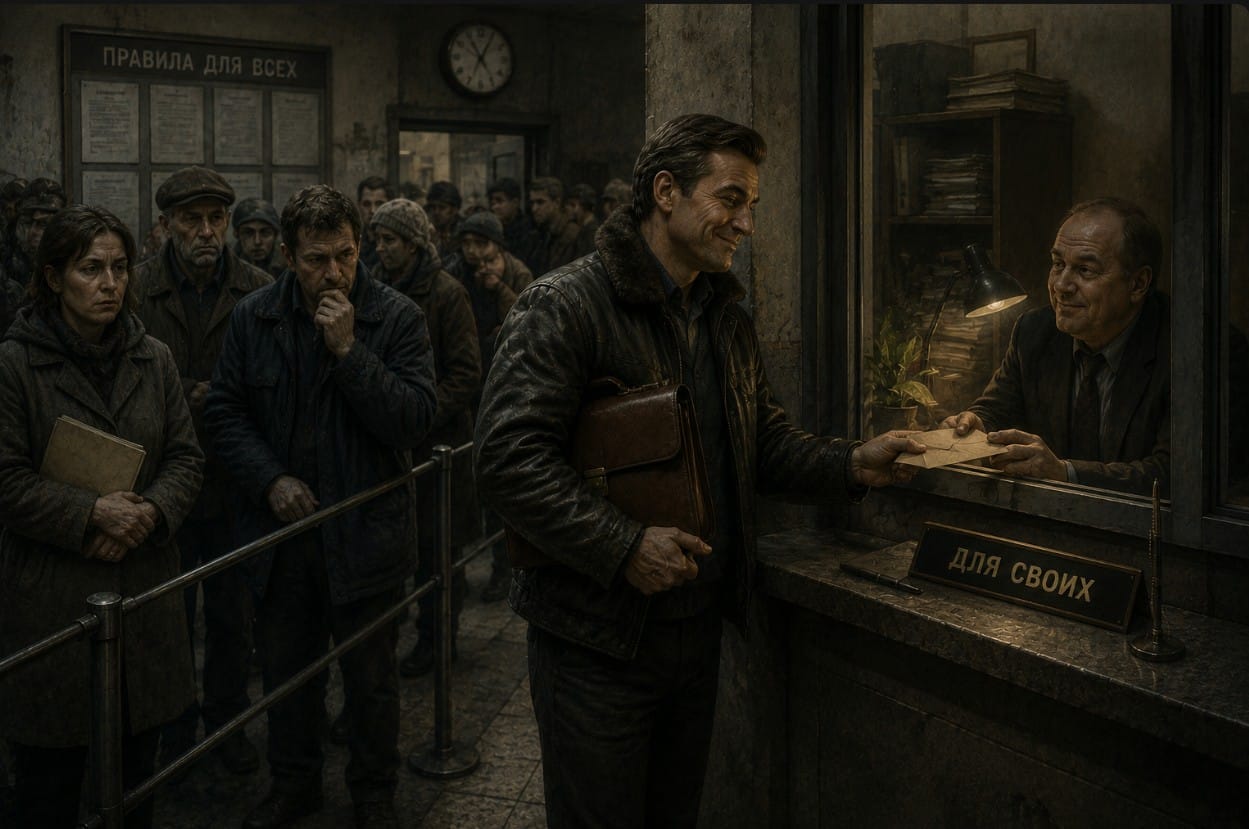
Imperial logic extends far beyond international politics. Sometimes it is much easier to notice it in the most ordinary everyday situations, where a person is not thinking about the state or ideology at all.
There is a traffic jam. One driver waits with everyone else. Another tries to bypass the queue by driving into the oncoming lane. If the police stop him, his next thought may no longer be about why he broke the rule, but about whom he can call, what official badge or ID he can flash, and whether there is some way to work something out. The real win is getting a personal exception.
That is what has always struck me most of all. A bad rule can continue to exist. An inconvenient system can remain just as inconvenient. The important thing is that I personally manage to find a loophole in it and end up slightly above everyone else.
Perhaps this is why Russia for so long had an almost respectful attitude toward people who “know how to sort things out.” They know the right people, can negotiate, move ahead in a queue, get around a restriction, or obtain something unavailable to an ordinary person. This ability is treated almost like a talent.
But behind it lies a fairly unpleasant logic. Instead of wanting the rule to become fair for everyone, the goal becomes joining the group of people who are allowed not to follow it. And gradually this habit becomes political.
We often argue about who exactly should be at the top. We need an honest president, an intelligent governor, a decent official — someone who will finally use enormous powers properly.
A different question comes up much less often: why are we so willing to believe that enormous powers should be in anyone’s hands at all?
Perhaps this is why replacing one specific person in power can sometimes seem like enough of a reform. Psychologically, it is easier for us to imagine a good boss than a system in which the boss simply cannot control other people’s lives however they want.
And this is where the everyday habit of “working something out” suddenly connects with politics. In both cases, a person tries to secure a more favourable place within the existing structure instead of asking why the structure itself is organised this way.
In my view, this is one of the most persistent traces of imperial thinking. The desire to be closer to the centre of power becomes stronger than the desire to make sure that the centre of power stops determining everyone else’s fate altogether.
The portrait is gone, but the nail is still there
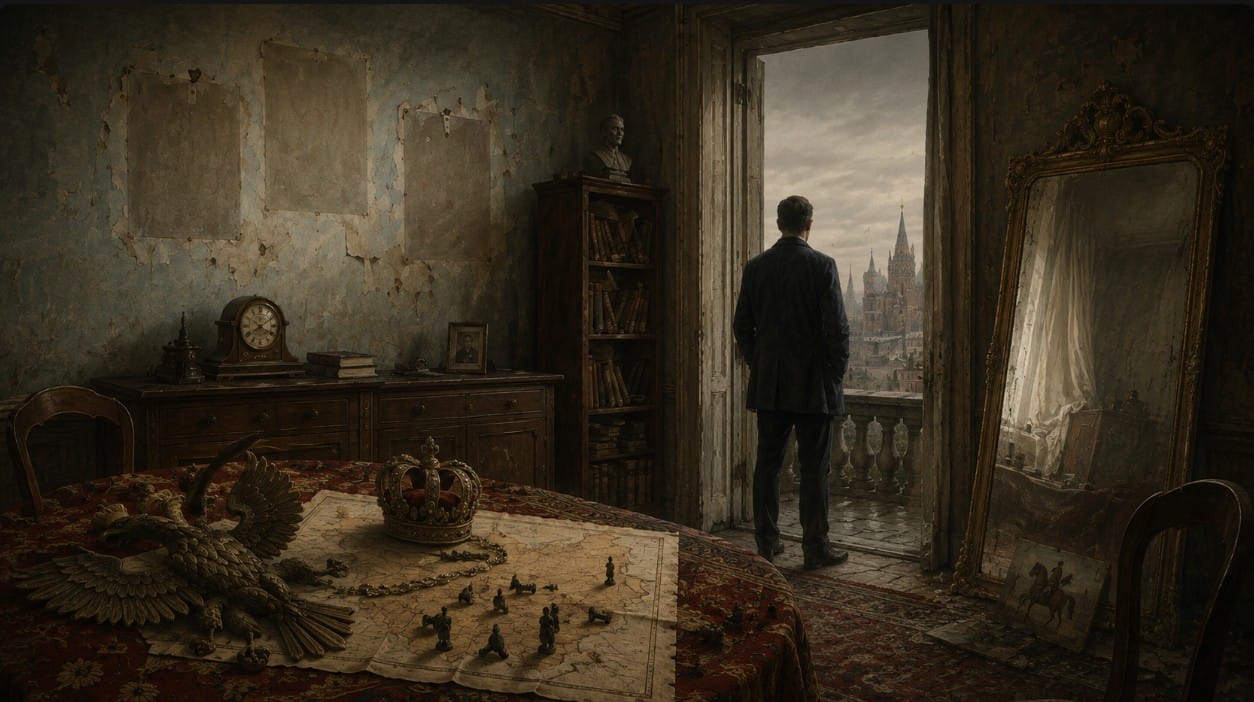
I think the old joke about taking down the portrait but leaving the nail in the wall describes a Russian political habit very accurately. We know how to become disappointed in a particular person. It is much harder to abandon the very idea that there must always be someone strong, intelligent, and right at the top who will one day put everything in order. That is why a change of government can so easily turn into waiting for a new good master. The portrait changes, but the place for it remains exactly the same.
And perhaps the most important question begins here. If one day Putin is truly gone, will we want to build a different system, or will we simply start looking for another person to hang on the same nail? After all, there was once a time when Putin himself did not want to “take Crimea,” but something went wrong, and now people in Ukraine are suffering.
Is a liberal empire possible?
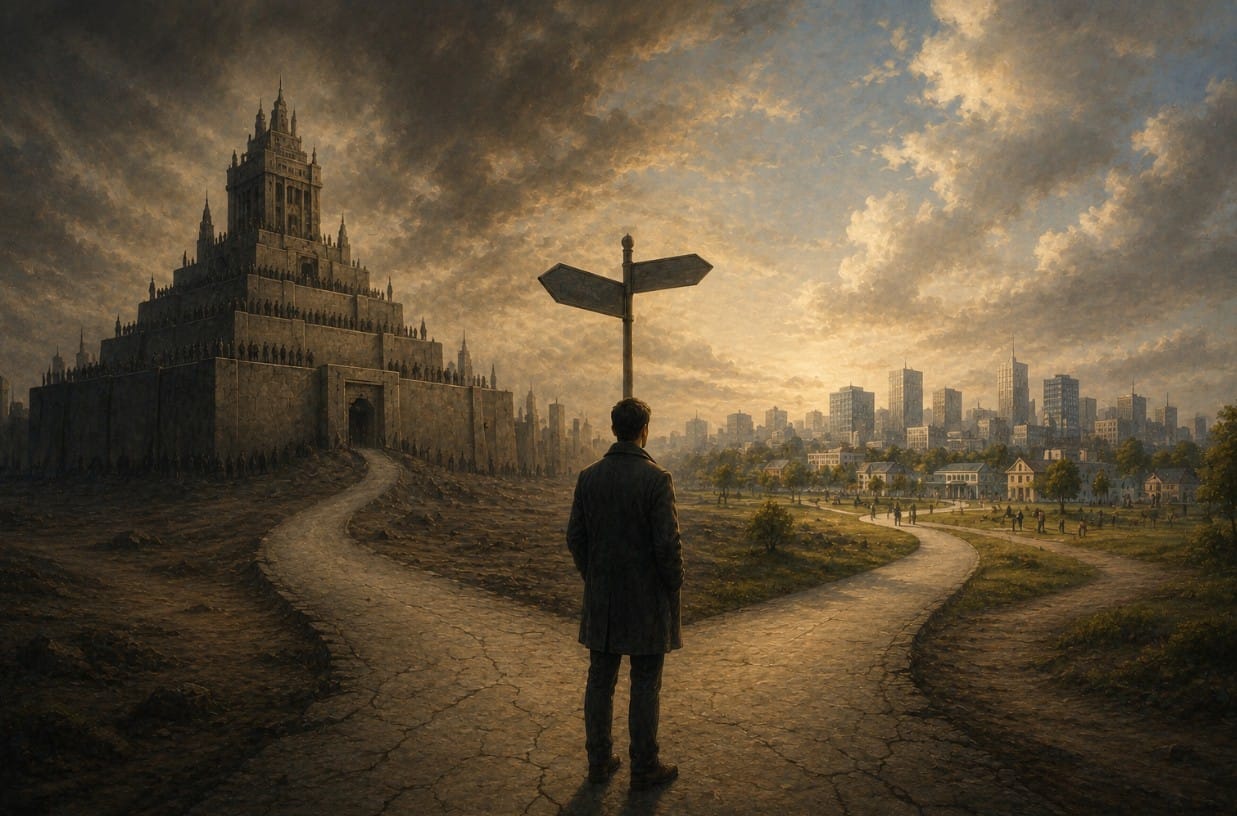
Perhaps this is where the main question appears for me. It is possible to imagine a future Russia with fair elections, independent courts, free media, and regular changes of government. But if the old habit remains of looking down on the regions and neighbouring peoples, treating enormous territory as a value in itself, and fearing any real autonomy, how deep have the changes really gone?
You can remove Putin and preserve imperial logic. You can make the system softer, more modern, and more respectable on the surface while leaving the same idea at its core — someone in the centre still knows better how everyone else should live.
And that is why it is becoming increasingly difficult for me to imagine a democratic opposition figure who remains an imperialist at the same time. At some point, you have to choose. Democracy requires recognising the right of others to determine their own future. Empire begins where that right is treated as dangerous.
I grew up inside this system too
It is important for me not to turn this text into an accusation against some abstract group called “Russians.” I grew up in the same environment and know many of these reactions very well from my own experience.
I also know the urge to become defensive when someone says unpleasant things about Russia. I have also caught myself making automatic judgments about people, regions, and neighbouring countries. Some of these habits become visible only when you start looking at yourself a little more carefully.
Perhaps that is why, for me, this article is first and foremost about reflection. I am interested in noticing things in myself that once seemed completely natural and gradually understanding where they came from.
Emigration gave me the chance to look at many familiar beliefs from the outside. And the longer I do that, the less I want to understand the world through the greatness of a country, and the more through the dignity of the individual.
You may also like these articles:
- Photo Report from Donauinselfest 2026. Part Two: Giant Rooks and Another Evening on the Island
- Photo Report from Donauinselfest 2026. Part One: My Ugly Clementine
- Marilyn Manson Live in Vienna: A Look Back at the Concert
- LP Live in Vienna: A Look Back at the Concert
- An Emigrant’s Observations: Anti-Putinism and the Imperial Lens
- It’s My Birthday Today!
- My Life in Austria: July 2026
- An Emigrant’s Observations: My Toxic Homeland —Yesterday, Today and Tomorrow
- Ricchi e Poveri Live in Vienna: A Night of Music and Memories
- An Emigrant’s Observations: Simple Ways to Support Your Emotional Well-Being
- Eisenstadt in Pictures: A Day in a Small Austrian City
- Exploring Vienna’s Neubaugasse Flea Market
- Sofia Isella Live in Vienna: A Concert Review
- An Emigrant’s Observations: When Mistakes Become Toxic While Adapting
- An Emigrant’s Observation: Extreme Heat in Europe and Austria in 2026
- My Emigration to Austria: June 2026 Recap