
What makes the history of the small Carinthian town of Straßburg remarkable is that for almost six centuries it was the residence of the bishops of Gurk. They ruled over extensive estates, built churches and castles, and gradually turned the town into one of the most important religious centres in Carinthia. It had its own court with the power to pass death sentences, a theological seminary, a bishop’s library and even a small Baroque theatre.
Straßburg
Straßburg (German: Straßburg) is a town in Austria, in the federal state of Carinthia, in the St. Veit an der Glan District. It lies in the Gurk valley, among the Gurktal Alps. As of 1 January 2026, the town had a population of 1,966. The historic centre lies at the foot of a medieval castle, the former residence of the bishops of Gurk.
History of the town
The area of present-day Straßburg was inhabited long before the medieval town came into being. Archaeological finds point to a human presence here as early as prehistoric times, and later in the days of the Roman Empire. A road ran through the Gurk valley, linking the Roman city of Virunum, one of the main centres of the province of Noricum, with the northern areas and the future Salzburg lands. It was the town’s position beside this road that later shaped the development of Straßburg.
After Carinthia came within the sphere of influence of the Bavarian and Frankish rulers, large church estates began to appear here. In 864, King Louis the German gave the Archbishopric of Salzburg lands in the Gurk valley. In 898, Emperor Arnulf granted extensive estates to a local nobleman, Sventibold, one of the ancestors of Saint Hemma of Gurk, who played an important role in the religious history of Carinthia.
Long before Straßburg itself appeared, there was a nearby settlement called Lieding, known since the 10th century. By 975 the Church of Saint Margaret was already in use there, and its construction is linked to Countess Imma, a relative of Saint Hemma. A monastery was meant to be founded, but the plan was never carried out. Lieding received market privileges and at first remained the main church centre of the surrounding area.
A decisive turning point came in 1072, when the Archbishop of Salzburg founded the Diocese of Gurk on land that had earlier belonged to Saint Hemma. At first the new diocese was subordinate to Salzburg and had a comparatively small territory. Its bishops, however, gradually strove for greater independence, and as their political influence grew, so did the need for a fortified residence of their own.
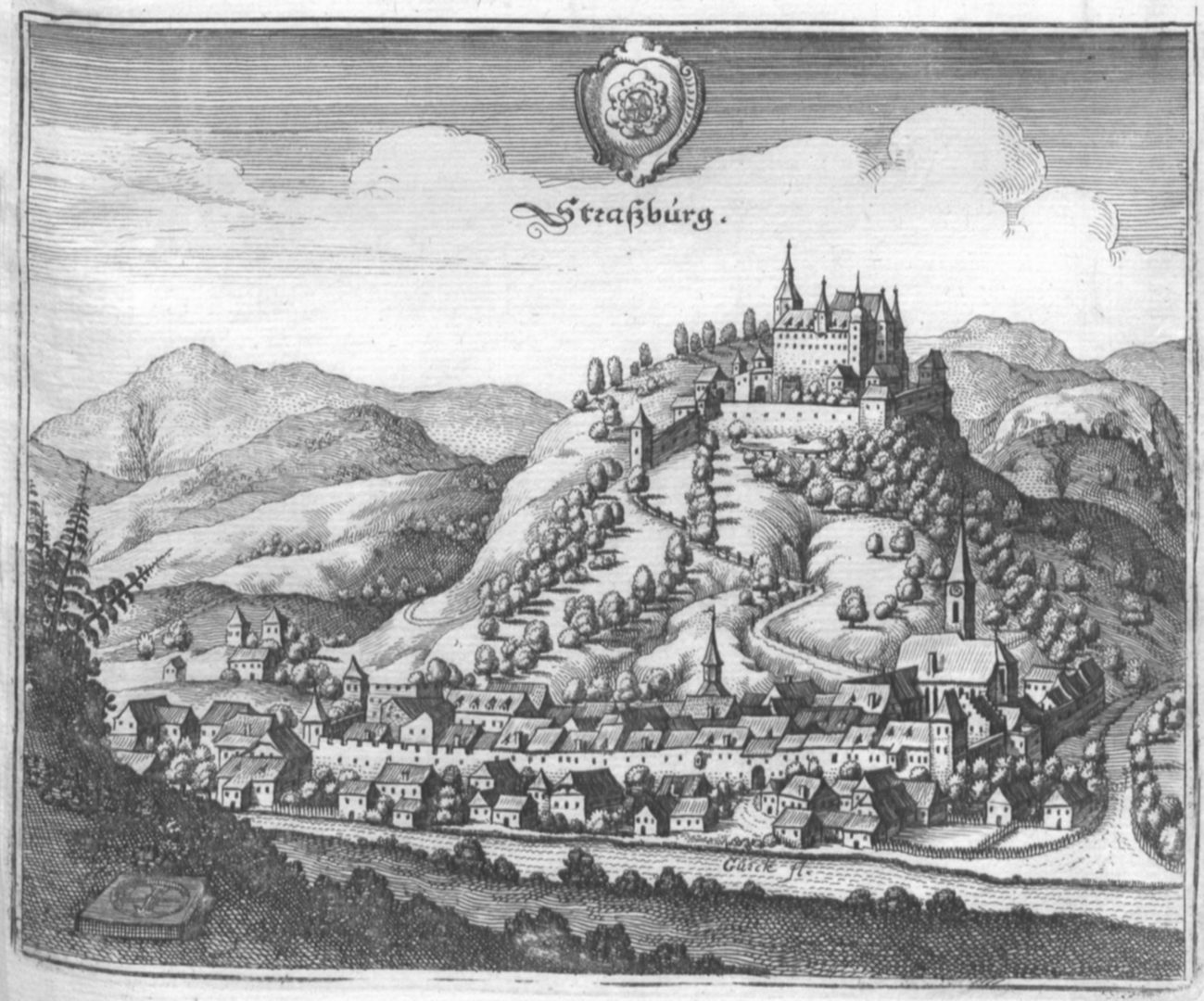
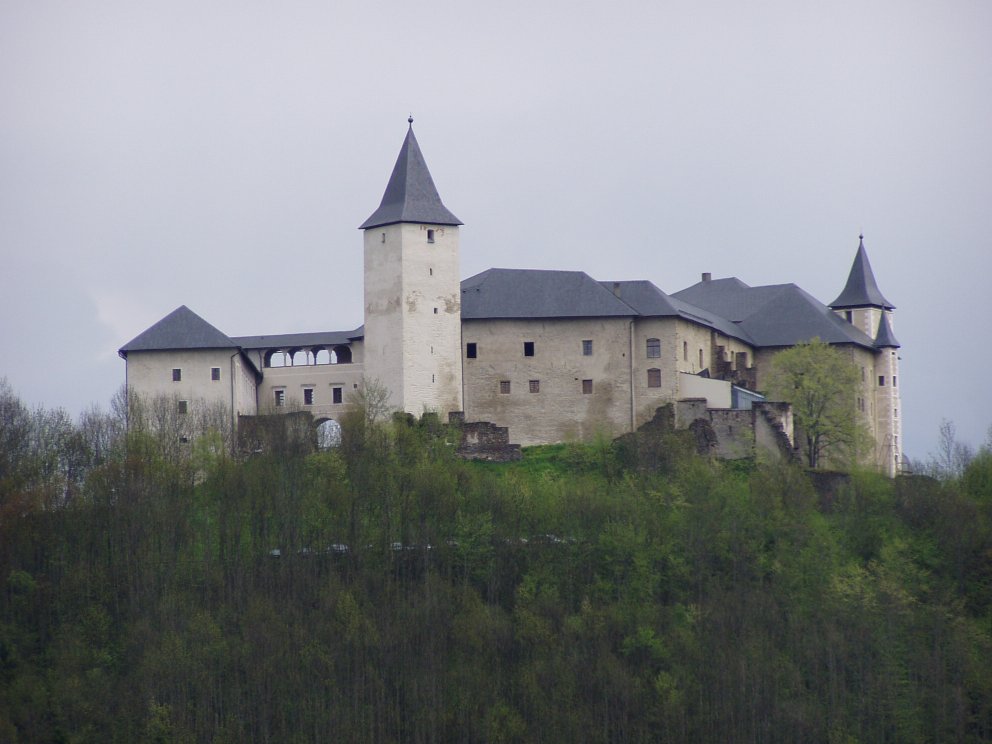
Under Bishop Roman I, who governed the diocese from 1131 to 1167, the fortress of Straßburg was built on a rocky outcrop above the valley. It is first mentioned in documents in 1147 under the name Strazburch. The structure controlled the road through the Gurk valley and at the same time served as the bishop’s residence. Building such a powerful fortification also had a political meaning: Roman wished to demonstrate the independence of the Diocese of Gurk from Salzburg.
Even the original structure occupied a considerable area. It was surrounded by a massive stone wall, and inside it stood a residential building, defensive towers and the Chapel of Saint Maurice. The castle was rebuilt many times afterwards, but its medieval core has survived to this day. During the years of conflict between Gurk and the Archbishopric of Salzburg, the fortress was besieged in 1179 and badly damaged in 1180. It was rebuilt afterwards.
Meanwhile, a new settlement was taking shape at the foot of the castle. As early as 1147 it is mentioned as a place for storing salt that was transported along the road through the Gurk valley. By 1169 there was a Church of Saint Nicholas, around which a small trading centre gradually formed. An important role in its development was played by Bishop Walter, who governed the Diocese of Gurk from 1200 to 1213. Under him the settlement acquired a regular layout, with an elongated rectangular square and streets running along the main road. Around 1200 the area was enclosed by a town wall with three gates, joining the settlement’s fortifications to the castle’s defensive system. Straßburg later expanded to the west and east, where the Gurk and St. Veit suburbs appeared, and later still development spread towards the river.
In 1229 Straßburg is documented for the first time as a market settlement. At about the same time, the local parish separated from the older parish of Lieding. The town now had its own church organisation and trading privileges, and the presence of the bishop’s residence attracted clergy, officials, merchants and craftsmen. The judicial powers of the bishops also expanded gradually. In 1280 King Rudolf I of Habsburg granted them the right of high jurisdiction. This allowed them to hear serious criminal cases and pass death sentences. The castle had dungeons, and on a nearby hill, the Galgenbichl, stood the place of execution. The stone supports of the old gallows have survived to the present day.
By the beginning of the 14th century Straßburg was already a well-organised church and administrative centre. In 1331 Bishop Gerold founded a collegiate chapter at the Church of Saint Nicholas: a community of six canons headed by a provost. It conducted services, handled church administration and managed its own income. Under the same bishop, around 1337, the Hospital of the Holy Spirit was established for the poor, the sick and the elderly. A small church was later built next to it, which has preserved valuable 14th-century wall paintings.
The bishop’s fortress was also being extended in this period, but between 1343 and 1368 a great fire destroyed a considerable part of the castle archive, which was kept at the chapel. It was a serious loss for the diocese: together with the documents, the written evidence of its estates, judicial rights and the early history of the residence disappeared.
By Antoni Boys – http://www.kulturpool.at/plugins/kulturpool/showitem.action?itemId=17179958246&kupoContext=default, Public domain, https://commons.wikimedia.org/wiki/Special:Redirect/page/41454074
Straßburg’s town rights developed gradually. It is thought that the town received some of its privileges as early as the first half of the 14th century, and a document of 1382 explicitly mentions a town judge and council. The residents could choose a candidate for judge, but the final appointment remained with the bishop. In 1402 Prince-Bishop Conrad III von Helfenberg confirmed the town’s rights. An old town seal has also survived, known from documents of the early 15th century. It shows an eight-petalled rosette, which later became the main symbol of Straßburg’s coat of arms. In 1455 Emperor Frederick III granted the town the right to hold an annual fair on 10 August, the feast day of Saint Lawrence.
Medieval Straßburg was not an exclusively Christian settlement. From the second half of the 13th century the presence of Jews here is documented, and their legal cases fell under the jurisdiction of the Jewish judge in Friesach. This shows that local trade and community life were connected with the wider economic relations of the region.
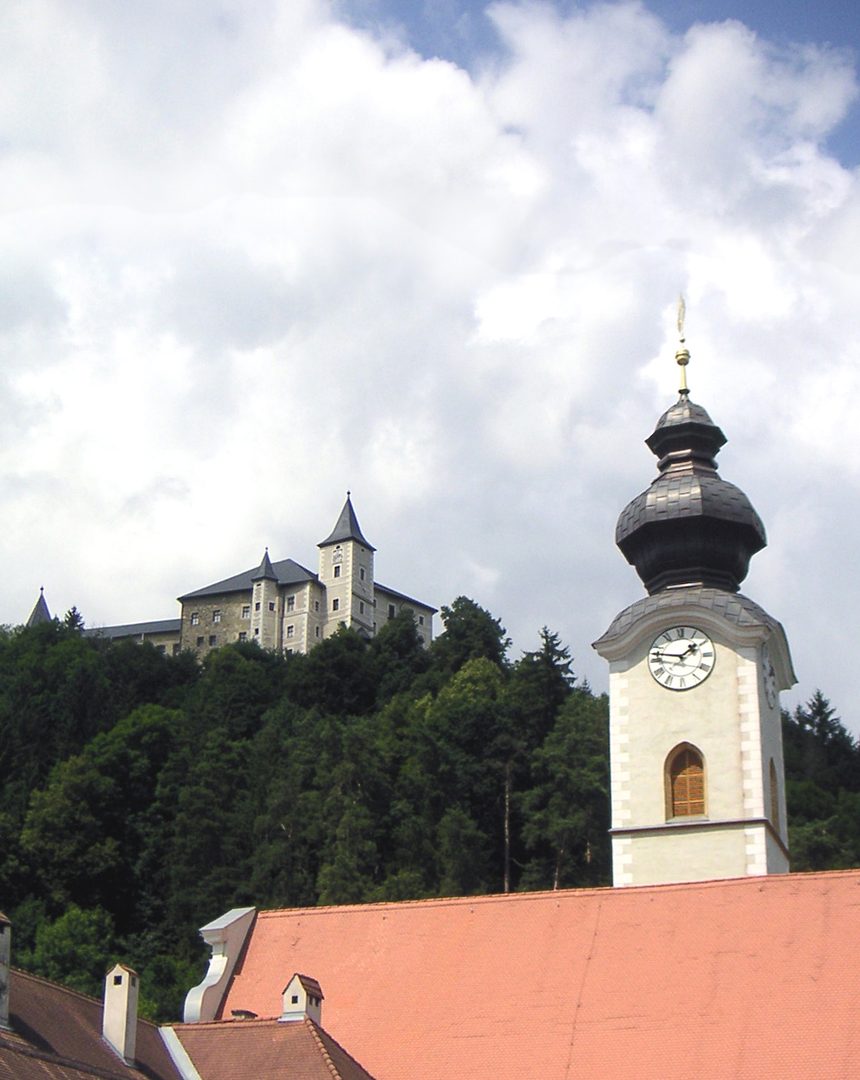
In the 15th century the town went through a notable building boom. In 1432 a large-scale reconstruction of the parish Church of Saint Nicholas in the late Gothic style began. The work continued until 1460 under Bishops Johann von Schallermann and Ulrich III Sonnenberger, and the church tower was completed in 1464. In 1444 Emperor Frederick III visited Straßburg in person and met Bishop Johann von Schallermann.
The castle was renewed as well. Under Ulrich III Sonnenberger the outer walls were strengthened and the living quarters enlarged, gradually adapting the medieval fortress to the needs of a princely residence. However, the proximity of the Habsburg lands to the territories that Ottoman troops were reaching created new dangers. During the Turkish raids of 1473 and 1476, various parts of Carinthia suffered, including the Gurk valley. In the following decades the defences of the town and the castle continued to be improved.
In the 16th century Straßburg was drawn into the religious conflicts of the Reformation. At first the Diocese of Gurk was affected by the spread of Lutheranism less than many other parts of Carinthia. Bishop Hieronymus Balbi, who headed the diocese from 1522 to 1526, opposed the new teaching and at a church assembly called on the clergy to remain faithful to Catholic traditions. Under his successors, however, Protestant ideas spread more and more among the population.
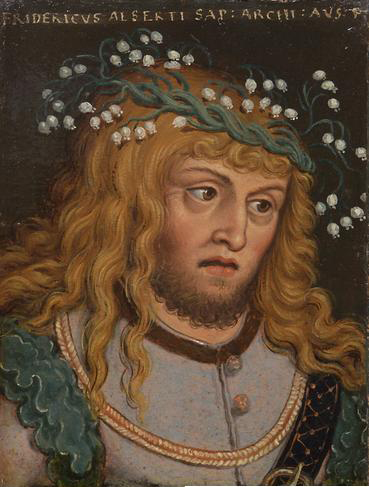
A special place in this story belongs to Bishop Urban Sagstetter, who governed the diocese from 1556 to 1573. He sought a compromise between Catholics and Protestants and supported communion for the laity in both bread and wine, which was one of the important demands of the supporters of the Reformation. There is a surviving record of a service in Straßburg in 1572 at which 66 people received communion in both kinds, and 112 according to the traditional Catholic rite.
At the same time, Sagstetter made a great contribution to the development of the town itself. Under him the bishop’s library was expanded, and the hospital and the Church of Saint Nicholas were supported. In 1562 the mayor of Straßburg is mentioned in documents for the first time, and in 1565 the bishop approved a town ordinance of 29 articles regulating the work of the local authorities. In the same year the town hall was completed, which Sagstetter gave to the townspeople. The residents took part in financing the building, contributing 66 gulden to the work.
After the Council of Trent, the Catholic Church began to strengthen religious education. In 1573–1603 Bishop Christoph Andreas von Spaur founded a seminary in Straßburg for training priests, one of the oldest in the German-speaking lands. The institution became an important part of the Catholic renewal and gradually turned the town into a centre for training the clergy of the Diocese of Gurk.
At the turn of the 16th and 17th centuries the bishop’s residence was considerably enlarged. In 1583–1584 the Italian architect Johann Anton Verda built a large service building with stables, grain stores and a state hall. Under Bishop Johann Jakob von Lamberg the castle was raised by two more floors, and by 1611 the southern residential wing was completed. In 1634 a tower with a spiral staircase appeared, connecting the old and new rooms.
At the same time the Counter-Reformation was gaining strength. Bishop Lamberg, who had been educated in Rome, consistently reinforced Catholic order, held church assemblies and inspected parishes. He also left the diocese a substantial library, liturgical items and other valuable objects.
In the 17th century local pilgrimage traditions also became important. In 1650 Bishop Franz von Lodron rebuilt the chapel at the foot of the castle hill, turning it into the Loreto Church. It housed a venerated image of the Black Madonna, and the shrine gradually became a place of pilgrimage. Between the castle and the town there was a covered staircase, parts of which have survived to this day.
Equally important changes took place under Cardinal Johann von Goëss, who governed the diocese from 1675 to 1696. Under him the castle gained two-tiered arcaded galleries around the inner courtyard, and in 1685–1686 a new Baroque entrance gate was built. The work was directed by masons and craftsmen invited from other parts of Austria. In 1689 the cardinal held a diocesan synod in Straßburg .
Outside the bishop’s residence, ordinary town life went on. Documents of 1673 mention weavers, dyers, blacksmiths, tanners, joiners, tailors, shoemakers, bakers and butchers. Most residents, however, still worked in agriculture. In 1688 a town guard is mentioned for the first time, and by the beginning of the 18th century there was a medical service and a pharmacy at the castle.
In the 18th century Straßburg continued to hold its importance as a bishop’s seat. Under Bishop Jakob Maximilian von Thun, who headed the diocese from 1709 to 1741, the castle had a small Baroque theatre, and the bishop himself was a patron of artists, among them the well-known Austrian painter Paul Troger.
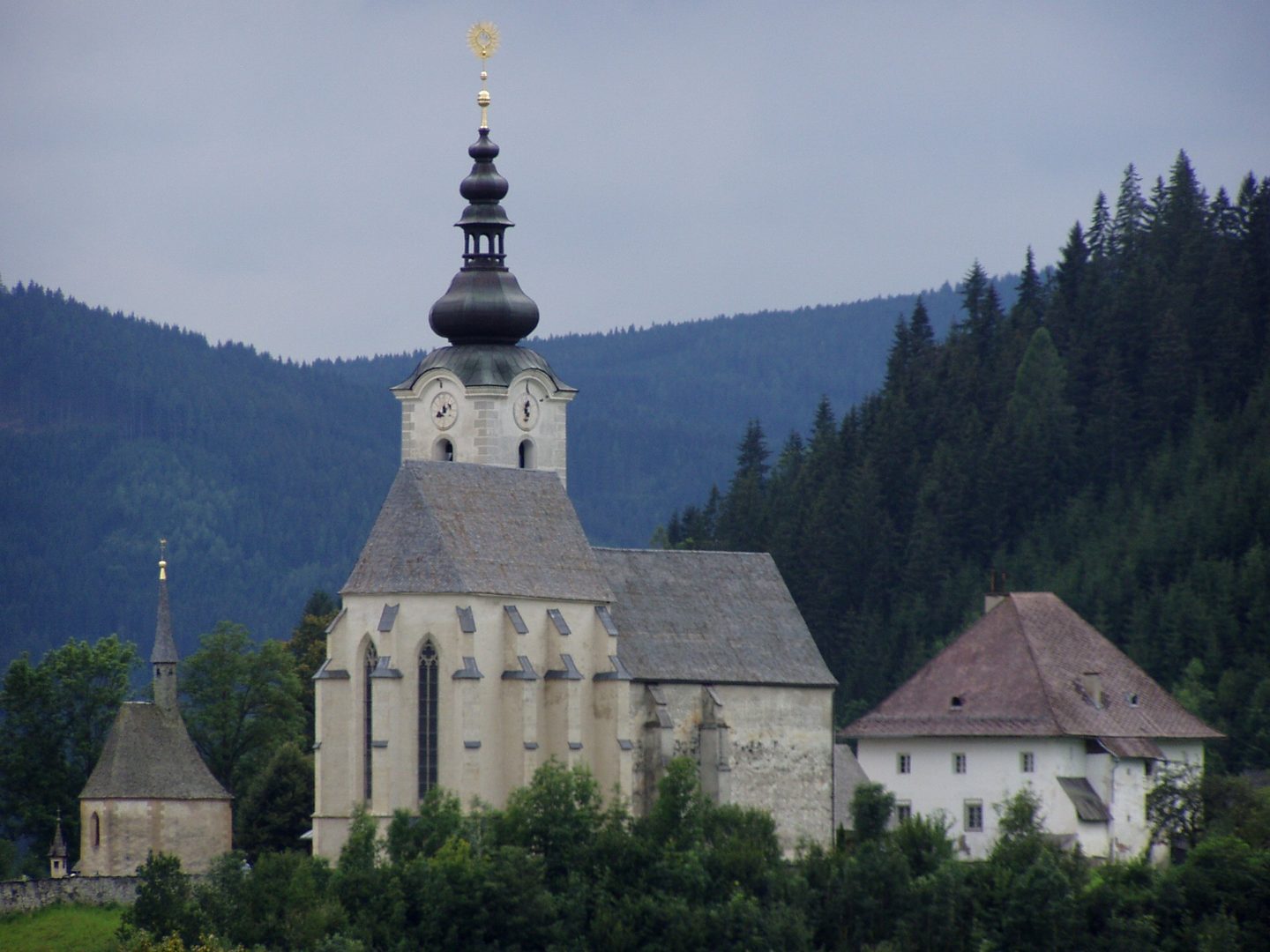
His successor Joseph Maria von Thun, who governed the diocese from 1741 to 1761, paid particular attention to education. He restarted the work of the theological seminary and took a personal part in running it, translated the New Testament into German, and set up a spinning school in Straßburg intended to improve the material situation of the local residents. At that time the building of the bishop’s residence near the Church of Saint Nicholas was also being rebuilt, and it later became the seminary’s premises.
However, on 21 November 1767 an event occurred that changed the town’s future. A strong earthquake seriously damaged the bishop’s castle. Restoring it would have required enormous expense, so the church authorities began to look for a new site for the residence. Bishop Joseph Anton von Auersperg ordered the construction of Pöckstein Castle at the confluence of the Metnitz and the Gurk, on the territory of the present-day municipality of Straßburg. The work, to a design by the Salzburg architect Johann Georg von Hagenauer, was carried out in 1778–1782. The new building became one of the most important monuments of early Neoclassicism in Carinthia. In 1783 the bishop’s residence temporarily moved to Pöckstein. But as early as 1787, in the course of Joseph II’s church reforms, Bishop Franz Xaver von Salm-Reifferscheidt moved it to Klagenfurt. At the same time the territory of the Diocese of Gurk, which had previously covered only a small part of Carinthia, was considerably enlarged. It now took in almost the whole federal state, which made Klagenfurt a more convenient administrative centre. For Straßburg this meant the end of a centuries-long era. The castle, which had served as the bishops’ residence since the time of Roman I, gradually emptied. The town still kept part of its former administrative importance, since the offices of the bishop’s regional administration remained here until 1858, but its former influence was never restored.
The last bishop to live in Straßburg, if only for a short time, Franz Xaver von Salm-Reifferscheidt, also went down in history as a patron of Alpine exploration. It was with his financial support that the expedition was organised which made the first ascent of the Grossglockner. After the bishop’s death in 1822 he was buried in the crypt of the town’s Church of Saint Nicholas.
In the 19th century Straßburg gradually turned into a small provincial town. Its residents also went through severe disasters. In July 1839 a serious fire destroyed a considerable part of the town’s buildings. Rebuilding required substantial funds, and many buildings of the historic centre acquired their later appearance precisely as a result of the 19th-century reconstruction.
The revolution of 1848 put an end to the old system of manorial lordships. After the abolition of serfdom and of the judicial power of the feudal lords, independent municipal communities began to form. In 1850 the present-day municipality of Straßburg was established, covering the territory of the former judicial district without Gurk. In 1851 a post office opened here. After another large fire that damaged the town’s buildings, a volunteer fire brigade was founded in 1877 on the initiative of the watchmaker Alois Prommer, and it became one of the most important local public organisations.
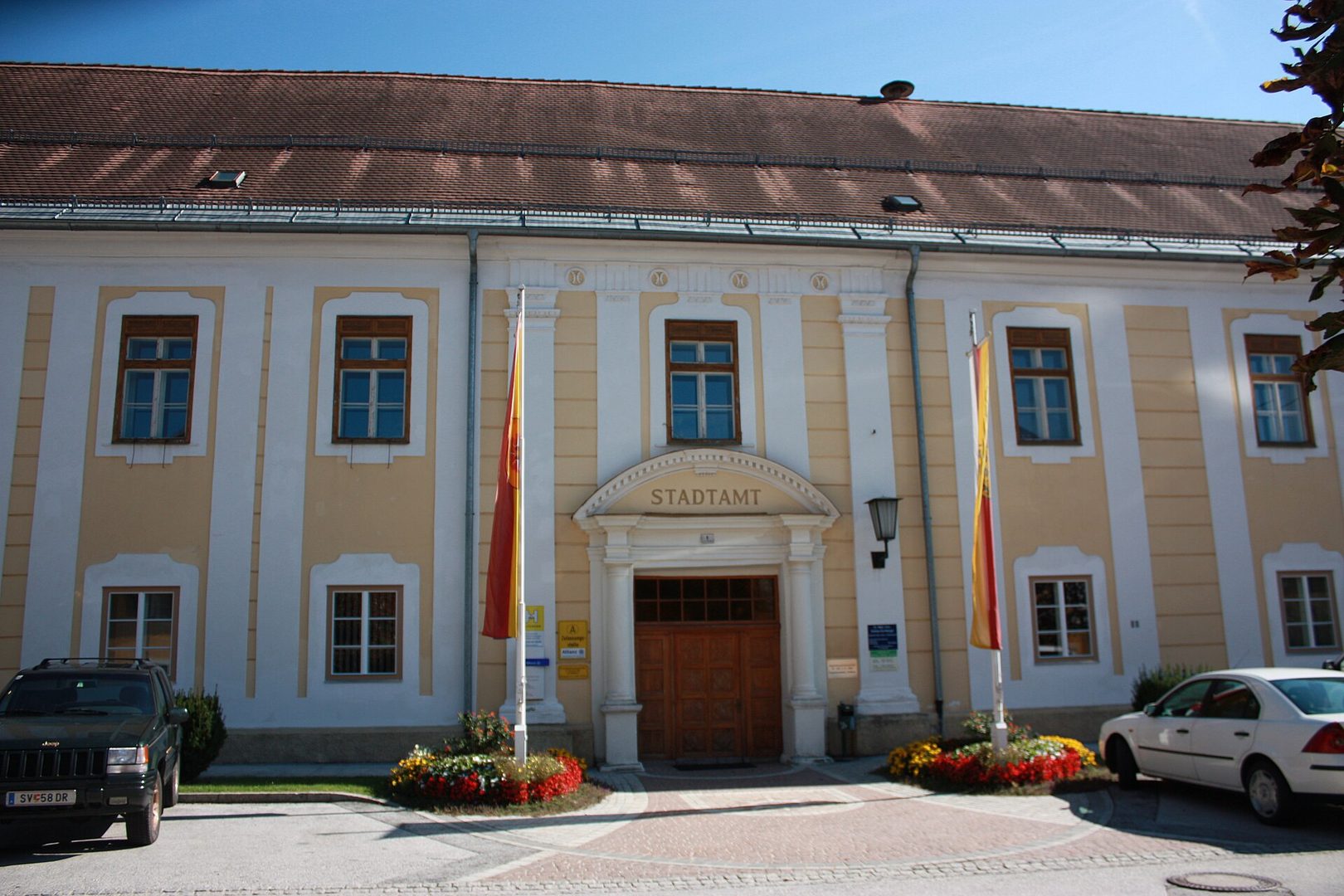
Meanwhile, the old bishop’s castle continued to decay. In the middle of the 19th century a lightning strike caused a fire that destroyed a considerable part of the roof. Despite attempts at repair, the buildings gradually fell into disrepair. In 1864–1865 there was even discussion of turning the abandoned complex into an asylum for the mentally ill, but the project was not carried out. Another fire after a lightning strike occurred in 1904, and in 1911–1915 part of the southern wing collapsed.
At the end of the 19th century Straßburg gained a new transport link. In 1898 the narrow-gauge Gurk Valley Railway opened, connecting Treibach-Althofen with the settlements of the Gurk valley, including Straßburg and Klein Glödnitz. The railway made it much easier to transport agricultural produce, timber and other goods, and to travel to the larger towns of Carinthia. Public infrastructure developed in these same years. In 1892 a men’s choral society appeared, in 1905–1906 a water supply and sewerage system were built, and in 1906 a local Raiffeisen cooperative was founded. In 1919 Straßburg got a telephone connection.
The First World War and the collapse of Austria-Hungary changed the political landscape of Carinthia. In the post-war years some residents and members of the local community tried to save the castle, which was falling into decay. In 1920 a committee for its preservation was created, but the limited funds were enough only for minor repairs. In 1924–1925 the municipal boundaries also changed. Straßburg gave the neighbouring municipality of Gurk part of its land, including Reichenhaus and parts of several settlements. This was one of the few major territorial changes since the municipality was formed in 1850.
During the Second World War the region again faced the consequences of destructive action. In 1945 Allied bombing damaged the Church of Saint Radegund in Hohenfeld, which lies within the present-day municipality. It was restored by 1948.
After the war ended, the fate of the bishop’s castle became a particularly acute question for Straßburg. The damaged roof and collapsed sections of wall created a danger, and the long absence of proper maintenance only sped up the decay. In 1954 the authorities even issued an order to demolish the structure. The decision, however, was prevented. In 1955 a new access road to the castle was built, and soon the society “Friends of Straßburg” began its work, bringing together local residents and supporters of preserving the historical heritage. A special role was played by a businessman from Klagenfurt, Ferdinand Pluder, who managed to attract funds for the restoration from the diocese, the regional authorities and private donors.
In 1956 large-scale rescue and restoration work began. First the most dangerous sections of wall were reinforced, and then the roofs, interior rooms and arcaded galleries were gradually repaired. In 1973–1976 the roof of the whole complex was completely renewed, using more than 6,000 square metres of natural slate. By the end of the 1980s a considerable part of the former residence had been restored.
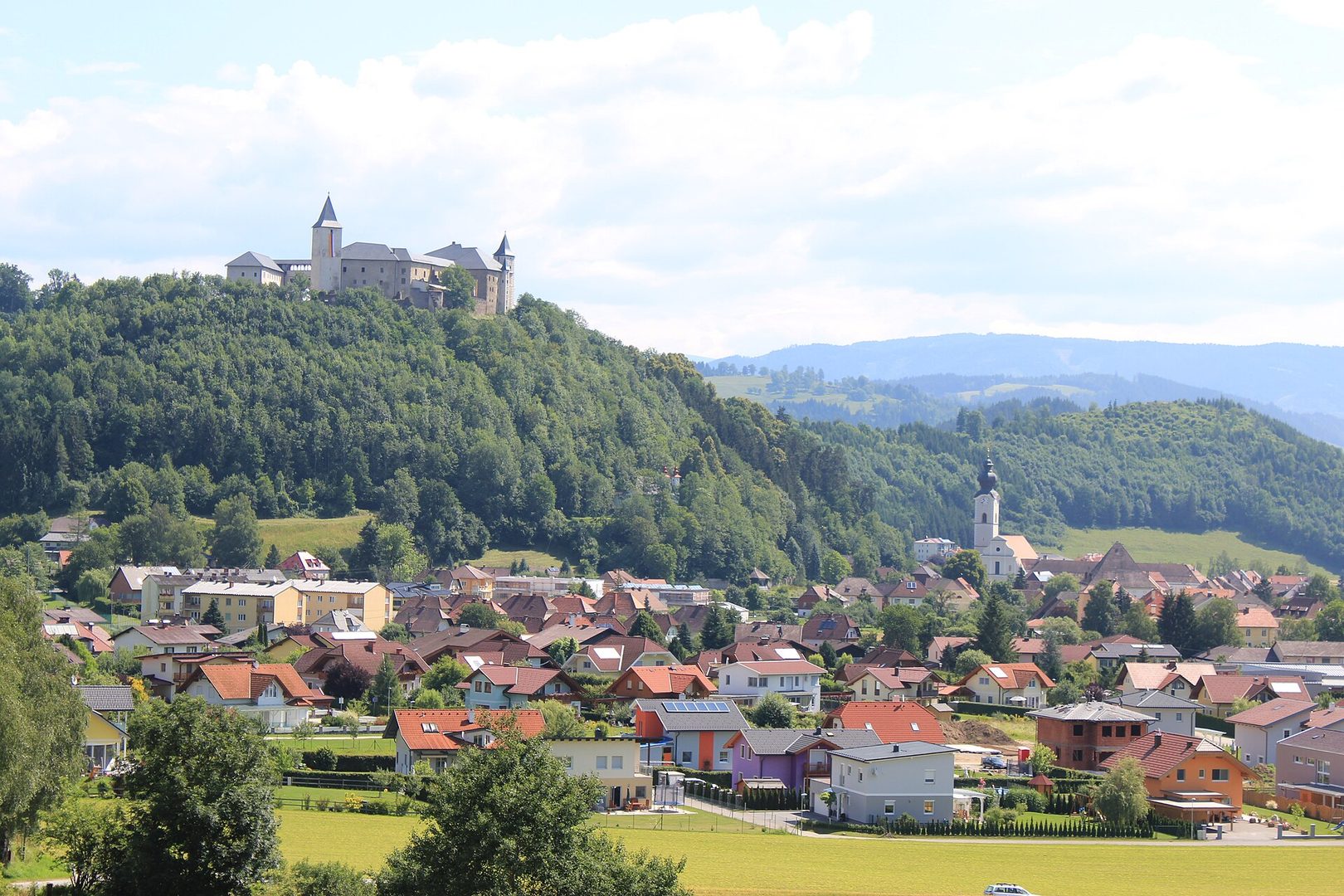
At the same time, the life of the community itself was changing. Road transport gradually pushed out the railway, and in 1972 services on the Gurk Valley line were finally discontinued. In Straßburg the tracks were removed, while near Treibach a short section survived and was later used for museum trains.
The restored castle became a cultural centre. Local history and historical exhibitions were opened here, and concerts, exhibitions and literary evenings began to be held. In the late 20th and early 21st centuries additional exhibition spaces appeared in the building, and in 2013 a historical exhibition, “Straßburg – Princely Residence and Episcopal Town”, was opened, devoted to the history of the Diocese of Gurk.
You may also be interested in the following articles from our “History of Austrian Cities” series:
About the project:
My name is Anatoly, and I am the author of Emigrants.life. In 2017, my family and I emigrated from Krasnodar to Austria. My wife and I work in marketing, and we created Emigrants.life to help people who are thinking about moving abroad.
Emigrants.life publishes daily news about life and everyday matters in Austria and Europe. Follow us on Facebook, Instagram and Twitter, or join our Russian-language Telegram channel.